






What's Happening?
Egypt's Ministry of Water Resources and Irrigation has announced a series of significant water projects in the Sinai Peninsula, aimed at enhancing agricultural expansion and food security. These initiatives were highlighted during the celebration of Sinai Liberation
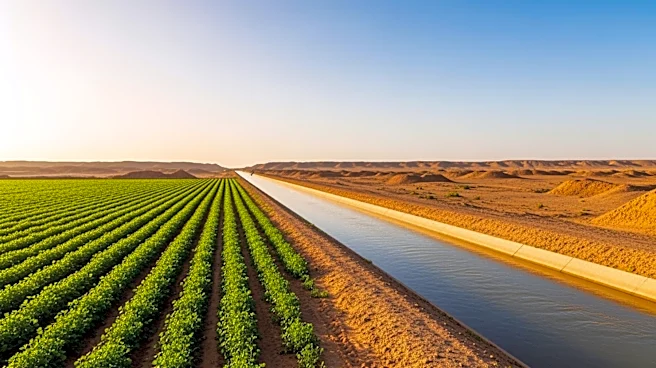
Day. Water Minister Hani Sewilam stated that the government is focusing on large-scale water management projects as part of a broader strategy for sustainable development in the region. A key project is the Bahr El-Baqar water treatment plant, which is one of the largest agricultural wastewater treatment facilities globally, with a capacity of approximately 5.6 million cubic meters per day. This plant will enable the reuse of treated water for irrigation in North and Central Sinai. Additionally, two major water conveyance routes are under construction, with 88% completion, expected to support the irrigation of around 270,000 feddans. The ministry is also developing 24 intake points along the Sheikh Jaber Canal to irrigate about 125,000 feddans, with most nearing completion. Furthermore, 16 integrated development clusters have been established across North and South Sinai, incorporating essential infrastructure to support local communities.
Why It's Important?
These water projects are crucial for Egypt's efforts to enhance food security and promote sustainable development in the Sinai Peninsula. By improving water management and expanding cultivable land, the initiatives aim to support agricultural growth and local community development. The projects are expected to provide significant economic benefits by increasing agricultural productivity and creating job opportunities. Additionally, the flood protection measures, including dams and artificial lakes, are designed to safeguard infrastructure and communities, while capturing rainwater for reuse. This comprehensive approach to water resource management is vital for addressing the challenges of water scarcity and climate change impacts in the region.
What's Next?
As the projects near completion, the focus will likely shift to operationalizing the new infrastructure and ensuring its effective integration into local agricultural practices. The government may also continue to monitor and evaluate the impact of these initiatives on food security and community development. Further investments in infrastructure and technology could be anticipated to enhance the efficiency and sustainability of water use in the region. Stakeholders, including local communities and agricultural businesses, will play a critical role in the successful implementation and long-term sustainability of these projects.
Beyond the Headlines
The development of water infrastructure in Sinai not only addresses immediate agricultural needs but also has broader implications for regional stability and economic development. By improving living conditions and creating economic opportunities, these projects could contribute to reducing migration pressures and enhancing social cohesion. Additionally, the focus on sustainable water management aligns with global efforts to address climate change and environmental sustainability. The success of these initiatives could serve as a model for other regions facing similar challenges.