






What's Happening?
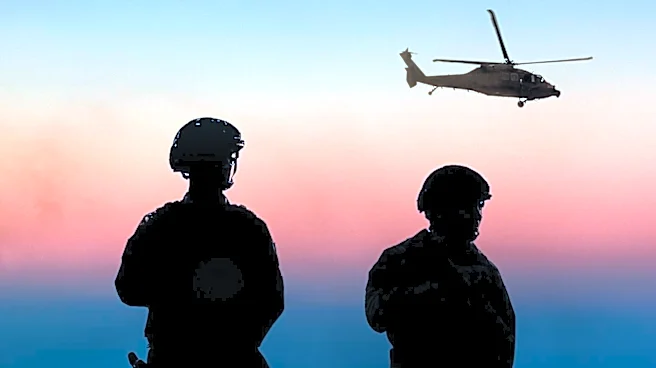
The United States Army recently deployed approximately 300 paratroopers to Hawaii, traveling 4,800 kilometers non-stop from Alaska. This operation, named Arctic Aloha, was led by the 11th Airborne Division and formed part of Rotation 27-01 of the Joint
Pacific Multinational Readiness Center. The primary objective was to test the U.S. military's capability to project forces over vast distances and execute a joint military entry within the U.S. Pacific Command's area of responsibility. A distinctive feature of the deployment was the in-flight preparation, where soldiers donned, adjusted, and inspected their parachutes and combat gear while still aboard the aircraft. Upon arrival in Hawaii, these paratroopers conducted a coordinated jump alongside an infantry company that had arrived from Japan, having participated in Operation Keen Sword.
Why It's Important?
This exercise is crucial for validating the U.S. military's strategic readiness and its ability to rapidly respond to contingencies across diverse geographic settings, particularly in the Indo-Pacific region. The long-distance deployment from Alaska to Hawaii, coupled with in-flight preparation, demonstrates advanced logistical capabilities and operational flexibility. It also tests the Army's new guidance, 'How the Army Fights,' which emphasizes concepts like convergence, attack, close combat, and endurance. By integrating with Japanese forces, the exercise reinforces interoperability with key allies, which is vital for collective security in the Pacific. This type of training ensures that the U.S. can project power effectively and secure strategic infrastructure in a dynamic operational environment.
What's Next?
Following the Arctic Aloha exercise, the members of the 11th Airborne Division will return to Alaska to conduct further airborne assault drills, continuing to refine their specialized skills for Arctic and Pacific operations. The insights gained from this deployment will inform future military doctrine, training methodologies, and equipment procurement, particularly concerning long-range force projection and joint operations. The successful execution of such complex exercises reinforces the U.S.'s commitment to its allies and its capacity to maintain a robust military presence in critical regions. Future rotations of the Joint Pacific Multinational Readiness Center will likely incorporate lessons learned to further enhance readiness and interoperability.
Beyond the Headlines
The Arctic Aloha exercise subtly highlights the evolving strategic focus of the U.S. military towards the Indo-Pacific region, reflecting geopolitical shifts and the increasing importance of maintaining a strong presence there. The emphasis on in-flight preparation and rapid deployment capabilities suggests a move towards more agile and less predictable military responses, potentially challenging traditional notions of logistical support and operational timelines. Furthermore, the collaboration with Japanese troops underscores the deepening military alliances in the region, which are critical for counterbalancing emerging threats and maintaining regional stability. This exercise is not just about military drills; it's a demonstration of strategic intent and a commitment to projecting power and influence in a complex global landscape.