





What's Happening?
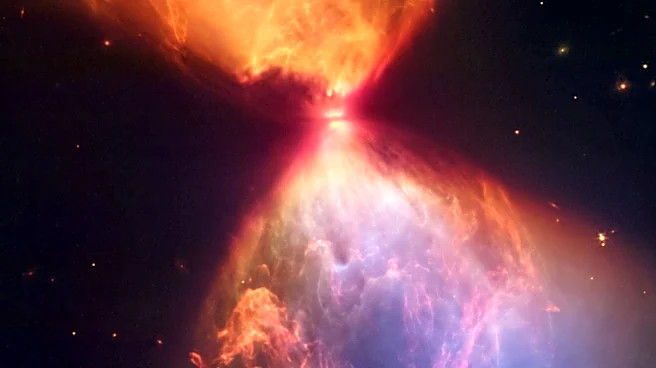
A study conducted by a team of researchers, including P. Fernández-Ruiz and A. Fuente, investigates the chemical conditions in protostellar envelopes, focusing on sulphur depletion during star formation. Using observations from the Yebes-40m and IRAM-30m
telescopes, the team analyzed sulphur-bearing species in Class 0 objects HH212 and NGC1333 IRAS4A. The study found significant differences in the abundance of these species compared to the Class 0 object B335. The research aims to understand the transition from pre-stellar to protostellar phases, with sulphur compounds serving as evolutionary tracers.
Why It's Important?
This research provides valuable insights into the chemical processes occurring during star formation, particularly the role of sulphur compounds as indicators of evolutionary stages. Understanding these processes is crucial for constructing accurate models of star formation and the development of planetary systems. The findings could have broader implications for astrophysics, as they contribute to the knowledge of how stars and their surrounding environments evolve over time. This study also highlights the importance of advanced observational techniques in uncovering the complexities of cosmic chemistry.