








What's Happening?
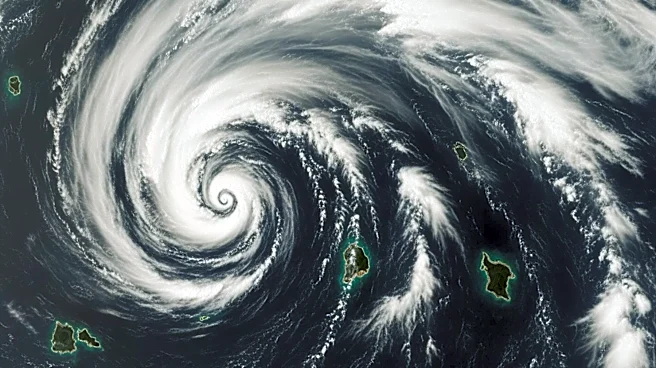
NASA's Global Precipitation Measurement (GPM) mission has provided detailed observations of Typhoon Sinlaku, which impacted the Pacific Islands of Guam, Saipan, and Tinian in April 2026. The GPM satellite, along with multi-satellite data-processing algorithms,
offered insights into the storm's rainfall patterns and intensity. The IMERG algorithm estimated significant rainfall accumulation, with predictions of 15 to 25 inches of rain for Saipan and Tinian. The GPM satellite's radar also captured the three-dimensional structure of the storm, revealing heavy precipitation and ice hydrometeors.
Why It's Important?
The data provided by NASA's GPM mission is crucial for understanding and predicting the behavior of severe weather events like Typhoon Sinlaku. Accurate rainfall estimates and storm tracking can aid in disaster preparedness and response, potentially saving lives and reducing economic losses. The ability to observe storms in three dimensions enhances meteorologists' understanding of storm dynamics, contributing to improved weather forecasting models. This information is vital for communities in the Pacific Islands, which are vulnerable to typhoons and other extreme weather events.
What's Next?
As the GPM mission continues to provide valuable data, efforts will focus on integrating these observations into weather prediction models to enhance accuracy. Collaboration with international meteorological agencies will be key to improving global storm tracking capabilities. Additionally, the development of new satellite technologies and algorithms will further advance the understanding of precipitation processes, benefiting both scientific research and practical applications in weather forecasting and climate monitoring.