







What's Happening?
On April 10, 2026, skywatchers across much of the United States had the opportunity to observe a rare astronomical event as the shadow of Ganymede, one of Jupiter's moons, crossed the planet's cloud tops. This event was visible from the western two-thirds
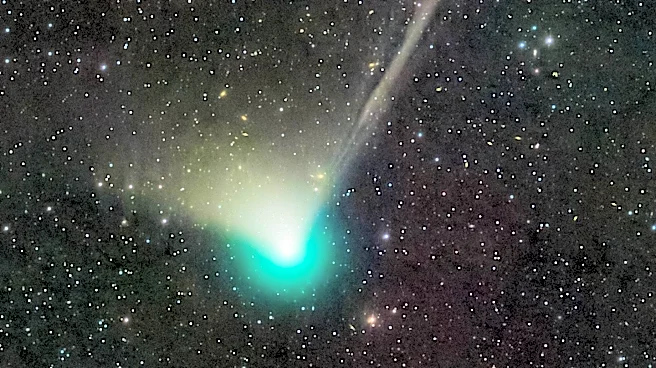
of the U.S., beginning at 12:57 A.M. CDT. Ganymede's shadow took over three hours to traverse Jupiter, providing ample time for observation. The event was part of a series of celestial occurrences, including the visibility of Comet Tempel 2, which is currently brightening in the constellation Scutum.
Why It's Important?
Events like the Ganymede shadow transit offer valuable opportunities for both amateur and professional astronomers to study celestial mechanics and the dynamics of Jupiter's moons. Such observations can enhance understanding of the solar system's largest planet and its satellites. Additionally, these events engage the public's interest in astronomy, fostering educational opportunities and inspiring future generations of scientists.
What's Next?
Following the Ganymede shadow transit, skywatchers can look forward to observing Comet Tempel 2, which is expected to brighten over the coming months. This comet will be visible in the southern sky, providing another opportunity for observation and study. Astronomers will continue to monitor Jupiter and its moons for similar events, contributing to ongoing research in planetary science.