



What's Happening?
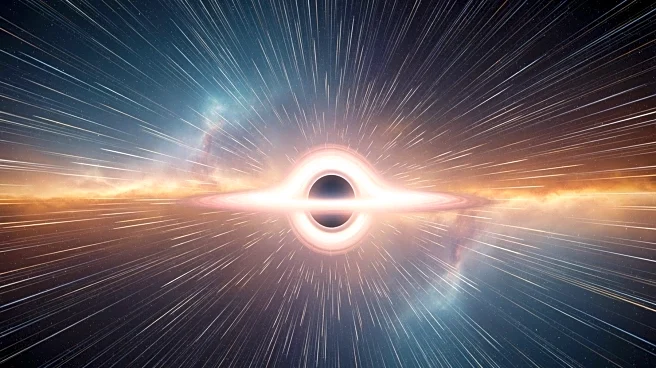
An international team of researchers has observed a unique event involving a supermassive black hole using the European Space Agency's XMM-Newton and XRISM telescopes. The black hole, located in the spiral galaxy NGC 3783, emitted a powerful X-ray flare
followed by ultra-fast winds traveling at 60,000 km per second. This phenomenon, observed for the first time, provides new insights into the behavior of black holes and their impact on surrounding space. The study, led by Liyi Gu from the Space Research Organization Netherlands, highlights the role of magnetic fields in generating these winds, drawing parallels to solar flares.
Why It's Important?
The discovery of ultra-fast winds from a supermassive black hole is significant for understanding the dynamics of active galactic nuclei (AGN) and their influence on galaxy evolution. These winds can affect star formation and the distribution of matter in galaxies, playing a crucial role in their development. The findings also contribute to the broader understanding of high-energy astrophysical processes, offering potential parallels to solar phenomena. This research enhances the scientific community's ability to model and predict the behavior of black holes, which are key to understanding the universe's structure and evolution.