






What's Happening?
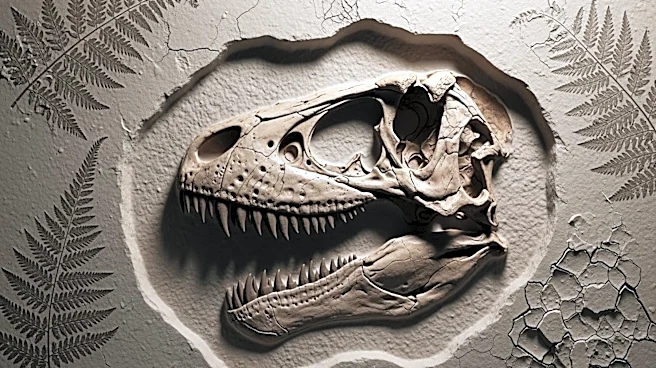
A geosciences student at Virginia Tech, Simba Srivastava, has identified a new species of carnivorous dinosaur from a heavily damaged skull fossil. This discovery, published in Papers in Palaeontology, reveals a species that lived over three times earlier
than the Tyrannosaurus rex. The fossil, initially overlooked due to its poor condition, was digitally reconstructed using advanced CT scanning, unveiling unique anatomical features. These features include pronounced cheekbones and a broad braincase, suggesting early dinosaurs were diversifying in unexpected ways. The species, named Ptychotherates bucculentus, provides new insights into the late Triassic period, a time of significant ecological competition and mass extinction.
Why It's Important?
This discovery is significant as it challenges existing assumptions about early dinosaur evolution and survival. The identification of Ptychotherates bucculentus suggests that the Herrerasauria, one of the earliest groups of carnivorous dinosaurs, survived much longer than previously believed. This finding could reshape scientific understanding of dinosaur ecosystems and their evolution during the late Triassic period. The research highlights the potential of modern imaging techniques to extract valuable scientific data from fossils once considered beyond recovery. It also underscores the importance of the American Southwest as a potential refuge for ancient predators, offering a new perspective on the region's paleontological significance.
What's Next?
The discovery of Ptychotherates bucculentus opens new avenues for research into the late Triassic period and the evolutionary history of dinosaurs. Further studies may focus on exploring other overlooked fossils using digital reconstruction techniques to uncover additional species and evolutionary patterns. The findings could prompt a reevaluation of existing fossil collections and encourage the use of advanced imaging technologies in paleontological research. Additionally, the American Southwest may become a focal point for future excavations, as researchers seek to uncover more evidence of ancient dinosaur lineages and their ecological roles.
Beyond the Headlines
The discovery of this new dinosaur species highlights the evolving nature of paleontological research, where digital tools are increasingly used to unlock secrets from damaged specimens. This approach not only enhances our understanding of Earth's distant past but also raises questions about how many other fossils might hold untapped scientific value. The study exemplifies the potential for undergraduate students to contribute significantly to scientific advancements, emphasizing the importance of fostering early involvement in research. As paleontology continues to integrate technology, the field may experience a paradigm shift in how fossils are studied and understood.