


What's Happening?
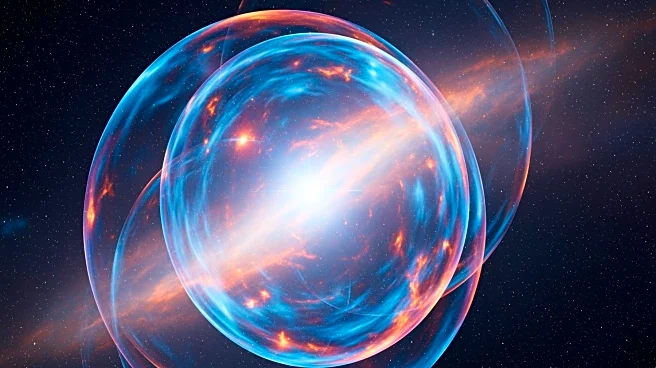
The Bubble Nebula, also known as NGC 7635, is an emission nebula located in the constellation Cassiopeia. It is characterized by a spherical shape formed by the interaction of a stellar wind from a massive central star, BD+602522, with surrounding nebular
material. The star, which is 40 times more massive than the Sun, emits a wind moving at 4 million mph, creating a visible boundary where the wind meets denser material. Discovered by Sir William Herschel in 1787, the nebula is faint and requires specific observational conditions to be seen clearly.
Why It's Important?
The study of the Bubble Nebula provides insights into the interactions between stars and their surrounding environments. Understanding these dynamics is crucial for comprehending the life cycles of stars and the formation of nebulae. The Bubble Nebula serves as a natural laboratory for studying the effects of stellar winds on interstellar material, which can influence star formation and the evolution of galaxies. Observations of such phenomena help refine models of stellar and galactic evolution.
What's Next?
Astronomers will continue to observe the Bubble Nebula using advanced telescopes and filters to gain a deeper understanding of its structure and dynamics. Future studies may focus on the variations in density within the nebula and how these affect the expansion of the bubble. These observations could contribute to broader research on the impact of stellar winds in different cosmic environments, enhancing our knowledge of the universe's complex processes.