








What's Happening?
Industrial-scale animal confinement, commonly known as factory farming, involves the intensive breeding and raising of animals for food production. A significant concern within this practice is the genetic engineering of broiler chickens, often termed
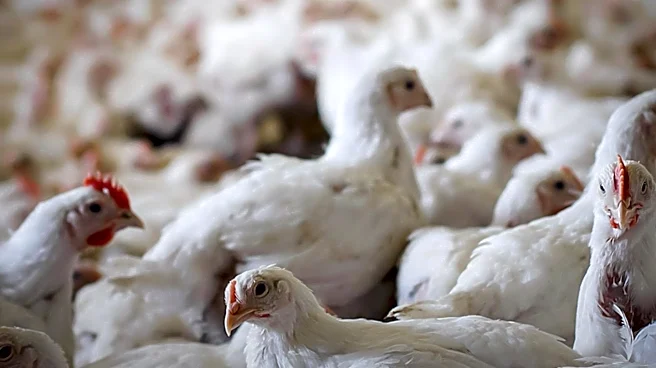
'Frankenchickens,' to achieve rapid growth and high body weight in a short period. This accelerated growth leads to severe physiological disorders in the birds. For instance, in the UK, approximately 90% of the 1.1 billion chickens slaughtered annually are considered 'Frankenchickens,' suffering from conditions such as broken bones and severe skin burns. These issues arise because their skeletal structures, cardiovascular systems, and internal organs cannot keep pace with their rapid muscle development. Historically, chickens grew to a modest weight in about 56 days, but modern 'Frankenchickens' reach over two kilograms in just 35 days. This practice is a core component of the industrial agricultural model, which relies on machinery, scientifically developed inputs, and large-scale facilities to meet commercial demands.
Why It's Important?
The widespread practice of genetically engineering broiler chickens for rapid growth has significant implications for animal welfare and potentially for the broader food industry. The severe physiological disorders experienced by these birds, including skeletal issues and organ failure, raise ethical questions about the sustainability and humanity of current industrial farming methods. While these methods aim to maximize production efficiency and meet consumer demand for poultry, the associated animal suffering could lead to increased public scrutiny and calls for reform. This could impact consumer choices, potentially shifting demand towards more ethically raised poultry or alternative protein sources. Furthermore, the reliance on intensive industrial agriculture highlights broader concerns about the environmental footprint and long-term sustainability of current food production systems, influencing policy discussions around agricultural practices and animal welfare standards.
What's Next?
The growing awareness of the welfare issues associated with 'Frankenchickens' is likely to fuel ongoing campaigns by animal protection organizations. These campaigns, such as the European Welfare Agenda and the Better Chicken Commitment (BCC), advocate for phasing out fast-growing breeds in favor of slower-growing alternatives. While some countries like Austria and Switzerland have already implemented stringent animal protection frameworks, and Denmark is moving to phase out fast-growing chickens in public procurement, the effectiveness of these reforms is debated. Critics argue that 'slower-growing' breeds may still suffer from similar deformities and that such changes could be a form of 'humane washing,' allowing the industry to continue exploitation under different labels. Future developments may include increased pressure on food companies and supermarkets to adopt higher welfare standards, potential legislative changes in more regions, and continued public discourse on the ethics of industrial animal agriculture.
Beyond the Headlines
The 'Frankenchicken' phenomenon extends beyond immediate animal welfare concerns, touching upon deeper ethical, legal, and cultural dimensions of food production. The genetic manipulation of animals for commercial gain raises fundamental questions about humanity's relationship with the natural world and the boundaries of biotechnological intervention. Legally, it could prompt debates over what constitutes acceptable animal husbandry and whether current regulations adequately protect animal sentience. Culturally, increased awareness might lead to a re-evaluation of dietary habits and a greater demand for transparency in food sourcing. The term 'Frankenchicken' itself reflects a societal discomfort with the unnatural aspects of modern food production, potentially signaling a long-term shift in consumer values towards more natural, sustainable, and ethical food systems. This could drive innovation in alternative protein development and reshape the agricultural landscape over the coming decades.