




What's Happening?
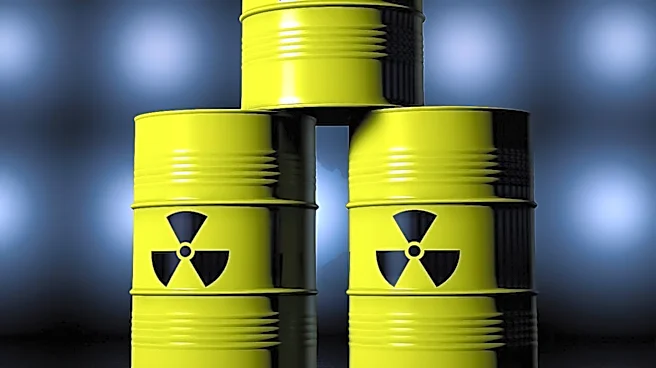
The International Atomic Energy Agency (IAEA) has reported that North Korea has constructed a new uranium enrichment facility at its primary Yongbyon nuclear complex. This new two-story building is estimated to be capable of housing up to 28 centrifuge
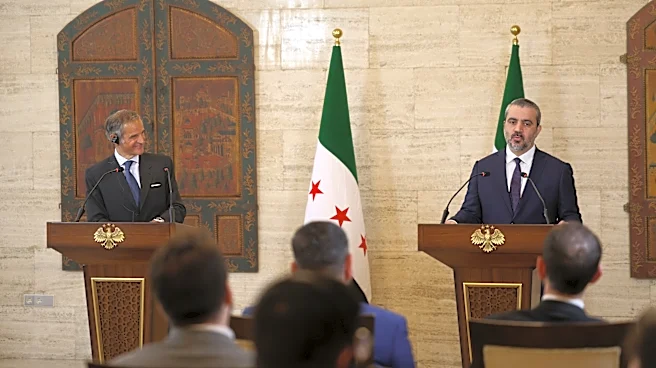
cascades. Additionally, North Korea has commenced operations at an expanded annex at its Kangson enrichment site. These developments were identified through satellite imagery and open-source materials, including photographs released by North Korean state media, as the IAEA has not had inspectors in North Korea since 2009. IAEA Director General Rafael Grossi expressed serious concern over these actions, stating that the ongoing operation and expansion of these facilities for producing weapons-grade nuclear material violate U.N. Security Council resolutions. The report, dated August 28, indicates a steady expansion of North Korea's nuclear infrastructure across multiple locations.
Why It's Important?
The expansion of North Korea's uranium enrichment capabilities at Yongbyon and Kangson signifies a significant advancement in its nuclear weapons program. This directly contravenes multiple U.N. Security Council resolutions aimed at preventing the proliferation of nuclear weapons. For the U.S. and its allies, this development poses an increased threat to regional and global security, potentially escalating tensions in the Korean Peninsula and beyond. The ability to produce more weapons-grade nuclear material enhances North Korea's capacity to develop and deploy more sophisticated nuclear devices, complicating denuclearization efforts. This also challenges the international non-proliferation regime, as North Korea continues to reject the IAEA's authority and its status as a nuclear weapons state outside the Non-Proliferation Treaty. The U.S. has consistently advocated for the complete, verifiable, and irreversible denuclearization of North Korea, and these actions undermine those diplomatic objectives.
What's Next?
In response to these findings, the international community, particularly the U.S. and its allies, is likely to consider further diplomatic and economic measures against North Korea. The U.N. Security Council may convene to discuss the implications of these violations and potentially impose additional sanctions. The U.S. will likely continue to monitor North Korea's nuclear activities closely through intelligence gathering and satellite surveillance. There could be increased calls for North Korea to return to denuclearization talks, though Pyongyang has repeatedly rejected the IAEA's authority and its status as a nuclear weapons state. The expansion of North Korea's nuclear infrastructure, coupled with its recent amendment to its constitution requiring an automatic nuclear response if its leader is killed, suggests a hardening of its nuclear posture, which could lead to further instability in the region.
Beyond the Headlines
The continuous expansion of North Korea's nuclear program, despite international condemnation and sanctions, highlights the limitations of current non-proliferation strategies. This situation raises deeper questions about the effectiveness of international diplomacy and sanctions in curbing the nuclear ambitions of determined states. The U.S. faces a complex challenge in balancing deterrence with the pursuit of denuclearization, especially as North Korea increasingly views its nuclear arsenal as a critical component of its national security and regime survival. The ethical implications of a state developing and potentially using nuclear weapons, coupled with the humanitarian concerns arising from the resources diverted to such programs in a country facing economic hardships, are profound. This ongoing development could also spur other nations in the region to reconsider their own security postures, potentially leading to a regional arms race and further destabilizing the geopolitical landscape.