




What's Happening?
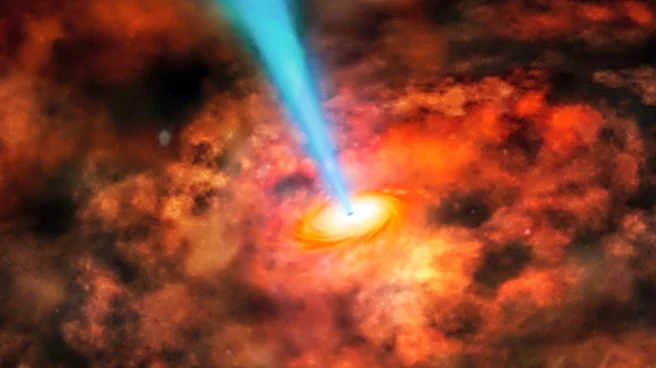
An international team of astronomers has discovered the oldest compact quasar pair ever observed, designated J1602+4228AB, also known as Nāpōwawā’enakulua. This pair formed when the universe was only 900 million years old, approximately one-thirteenth
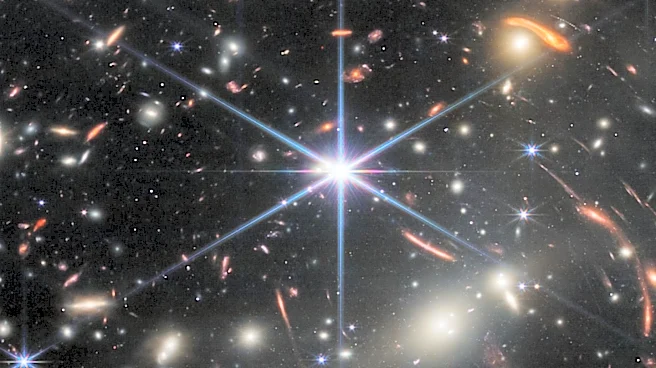
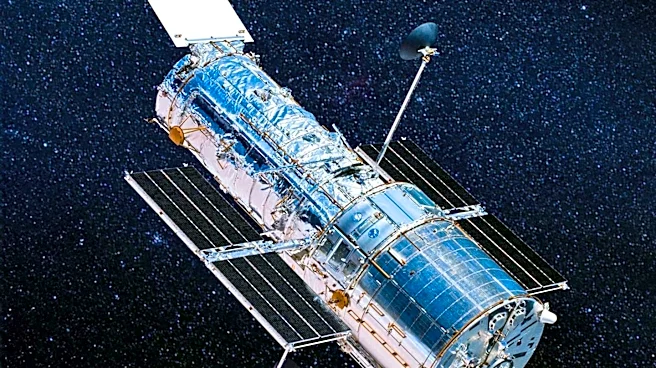
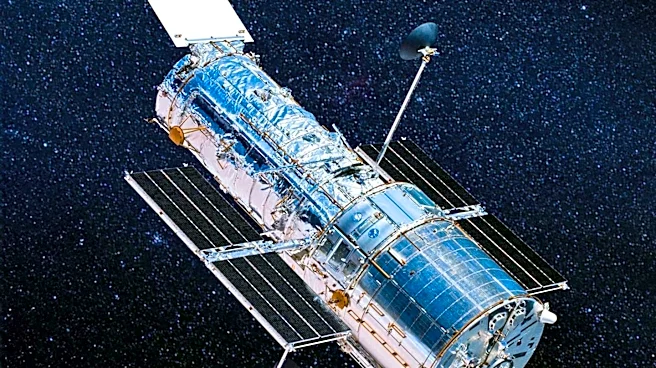
of its current age. The quasars are powered by supermassive black holes, each with masses of 1.5 billion and 400 million times that of the Sun, and are separated by 18,100 light-years. This discovery, detailed in the Astrophysical Journal Letters, challenges existing theoretical explanations for how such massive quasars could have formed so early in the universe's history. Silvia Onorato, lead researcher from NOIRLab in the United States, stated that there is no definitive theoretical explanation for the formation of even a single massive quasar at such an early age, let alone two. The James Webb Space Telescope (JWST) and the Gemini North telescope were instrumental in this finding.
Why It's Important?
This discovery significantly impacts our understanding of the early universe and the formation of supermassive black holes and galaxies. Current models suggest that black holes require at least a billion years to accumulate enough mass to reach the sizes observed in Nāpōwawā’enakulua. The presence of such massive and closely-packed quasars at only 900 million years after the Big Bang indicates that black hole growth and galaxy formation occurred much faster than previously thought. This challenges established astrophysical frameworks and necessitates a re-evaluation of the conditions and processes that governed the cosmic dawn. The findings could lead to new theories about the density of matter in the early universe and the mechanisms that triggered rapid star formation and black hole growth, potentially altering our fundamental understanding of cosmic evolution.
What's Next?
The discovery of Nāpōwawā’enakulua is expected to spur further research and observations to refine existing models of black hole and galaxy formation. Astronomers will likely use advanced telescopes like the James Webb Space Telescope to search for more such early-universe objects and gather additional data. The unique nature of this quasar pair provides a 'laboratory' for studying the interactions between early massive galaxies and their central black holes. Future studies will aim to unravel the mystery of how these objects formed so rapidly, potentially leading to breakthroughs in our understanding of the universe's initial evolutionary stages. The scientific community will be focused on developing new theoretical explanations that can account for these unexpected observations.
Beyond the Headlines
The profound implications of this discovery extend beyond astrophysics, touching upon the very limits of our current scientific understanding. The existence of Nāpōwawā’enakulua suggests that the universe's early history was far more dynamic and complex than previously imagined. This could lead to a paradigm shift in cosmology, prompting scientists to reconsider fundamental assumptions about the universe's initial conditions and the speed at which cosmic structures can emerge. The ongoing quest to understand these ancient cosmic beacons highlights the iterative nature of scientific discovery, where new observations constantly challenge and refine established theories, pushing the boundaries of human knowledge about the cosmos.