


What's Happening?
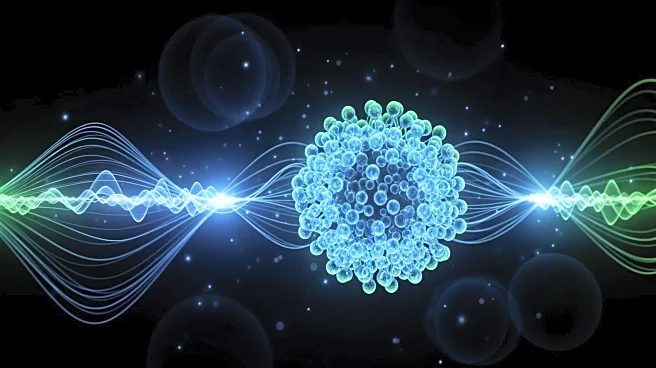
Physicists have successfully observed a superfluid transforming into a supersolid and back again, marking a significant milestone in quantum physics. This transition was achieved by researchers who studied excitons, quasiparticles that consist of an electron
and an electron hole, under extreme conditions. The study, published in the journal Nature, involved cooling excitons to just above absolute zero, where they initially formed a superfluid. Upon further cooling, the excitons transitioned into a supersolid, a state theorized to maintain the zero viscosity of superfluids while forming an orderly structure akin to a crystal lattice. This natural phase transition was achieved without the need for additional equipment or energy, unlike previous experiments that required external forces to create supersolids.
Why It's Important?
This discovery is pivotal as it opens new avenues for understanding quantum phases of matter, which could have profound implications for future technologies. The ability to naturally transition between superfluid and supersolid states could lead to advancements in quantum computing and materials science. Supersolids, with their unique properties, might be harnessed for developing new types of sensors or quantum devices that operate at higher efficiencies. The research also enhances our understanding of particle physics, potentially leading to breakthroughs in how we manipulate and utilize quantum states for practical applications.
What's Next?
The research team plans to explore other materials to further investigate the properties of the exciton supersolid state. They aim to develop new tools to measure and study this state more directly, which could provide deeper insights into its characteristics and potential applications. Continued research in this area may lead to the discovery of higher-temperature supersolids, making them more feasible for practical use. The scientific community will likely follow these developments closely, as they could redefine our approach to quantum materials and their applications.