






What's Happening?
After more than four decades of searching, physicists have found experimental evidence of an exceedingly rare and unstable particle decay, occurring only once in ten billion events. The LHCb Collaboration announced this discovery in a seminar on November
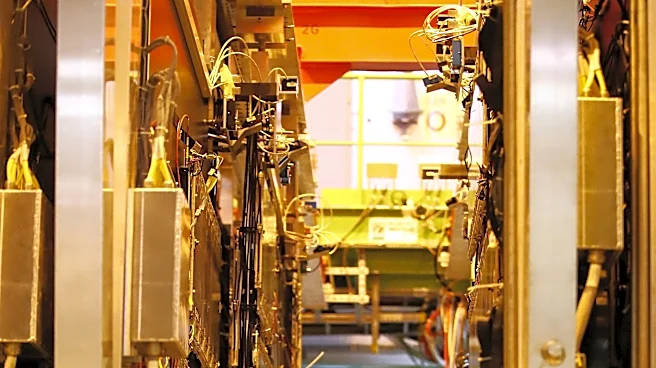
3rd and in a preprint paper, detailing the potential detection of a B d meson decaying into a muon and an anti-muon. This meson, composed of a beauty quark and a down antiquark, is incredibly fleeting, decaying in one and a half trillionths of a second. The experiment, conducted at the Large Hadron Collider Beauty (LHCb) at CERN, leveraged recent upgrades to boost particle collision detection rates and machine learning techniques to enhance the signal-to-noise ratio. This evidence, combining data from 2011-2018 and 2024-2025, achieved a significance level of 3.2 sigma, indicating a low probability of it being a fluke.
Why It's Important?
This discovery is a significant step forward in particle physics, providing a powerful new test of the Standard Model and potentially opening a window into new physics beyond it. The Standard Model, while successful, does not explain phenomena like dark matter or the matter-antimatter asymmetry in the universe. Observing such a rare decay with high precision can reveal subtle discrepancies that point to undiscovered particles or forces. This research helps address fundamental questions about the universe's origins, including what happened immediately after the Big Bang and why normal matter exists. The increasing sensitivity of particle colliders and advanced analytical techniques are crucial for probing the 'zeptoverse,' a realm of unimaginably small scales where new physics might reside.
What's Next?
To achieve the 'gold standard' 5-sigma significance value required for a confirmed discovery, further research and data collection will be necessary. Future upgrades to the Large Hadron Collider in the 2030s are expected to significantly increase the number of collisions and data collection rates, which will be crucial for confirming this rare decay. If confirmed, this finding could guide theoretical physicists in developing new models that extend beyond the Standard Model. It could also lead to a deeper understanding of the properties of quarks and other fundamental particles, potentially revealing indirect evidence of new physics that is not directly observable at current energy levels.
Beyond the Headlines
The search for and discovery of such rare particle decays represent humanity's relentless pursuit of understanding the most fundamental aspects of reality. This work at CERN is not just about finding new particles; it's about piecing together the cosmic puzzle of how the universe came to be and what its ultimate fate might be. The implications extend to our understanding of the very fabric of space-time, the nature of mass, and the forces that govern everything around us. The use of advanced machine learning in these experiments also highlights the growing synergy between artificial intelligence and fundamental scientific research, enabling discoveries that would be impossible through traditional methods alone. This ongoing quest pushes the boundaries of human knowledge and technological capability.