




What's Happening?
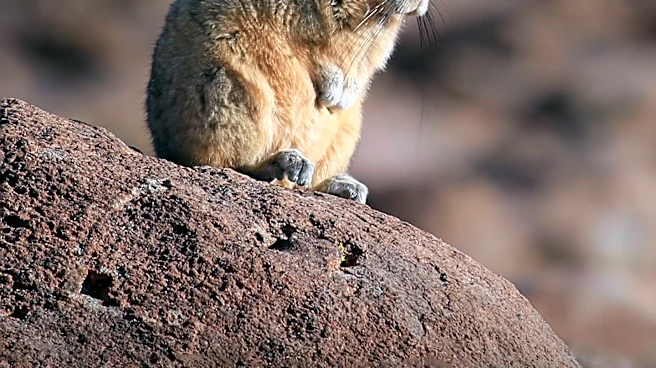
Researchers have gathered new information about the Wolffsohn’s viscacha, a rare rodent found in the high-altitude Andes of Patagonia in Argentina and Chile, leading to its reclassification from Data Deficient to Endangered on Argentina’s national Red
List. This reclassification is a result of a project supported by the Conservation Leadership Programme (CLP), which involved surveying 66 sites across remote Patagonian mountains. The team, co-led by Morgan Pendaries and Lucas Hormachea, discovered new colonies and evidence of local population declines. They also gained new insights into the rodent's behavior, determining it is more nocturnal than previously thought. Threats to the species include interactions with invasive European hares and feral dogs, avoidance of areas popular with mountain climbers, and the increasing effects of climate change on the Patagonian Andes ecosystem.
Why It's Important?
The reclassification of the Wolffsohn’s viscacha to Endangered highlights the critical state of biodiversity in the Patagonian Andes and underscores the urgent need for conservation efforts. While this reclassification is specific to Argentina, it reflects broader concerns about species vulnerability in the face of environmental changes and human activity, which can have implications for global conservation strategies. The findings emphasize the impact of invasive species, human recreational activities, and climate change on fragile ecosystems. For the U.S., this serves as a reminder of interconnected global ecological challenges and the importance of international collaboration in conservation. The research methodology, involving extensive fieldwork in extreme conditions, also showcases the dedication required to study and protect elusive species, contributing valuable data to the scientific community and informing future conservation policies.
What's Next?
Although the Wolffsohn’s viscacha is now listed as Endangered on Argentina’s Red List, this designation does not automatically grant it legal protection. A legislative proposal is being developed to declare the species a Natural Heritage Monument in Argentina’s Santa Cruz province. If approved, this would protect the viscacha under the country’s National Parks Law, similar to other protected species like the taruca and jaguars. Concurrently, the CLP team is collaborating with researchers in Chile to pursue a global IUCN Red List assessment for the species, which would provide international recognition of its conservation status and potentially unlock further resources and coordinated efforts for its protection across its range in both Argentina and Chile. These steps are crucial for ensuring the long-term survival of this elusive rodent.
Beyond the Headlines
The story of the Wolffsohn’s viscacha delves into the ethical and practical challenges of conservation in remote and extreme environments. The researchers' arduous work in conditions without electricity or internet access, enduring freezing temperatures and strong winds, highlights the dedication required for scientific discovery and conservation. The reclassification from 'Data Deficient' to 'Endangered' underscores a common issue in conservation: species can be at significant risk even when data is scarce, emphasizing the importance of proactive research. The threats identified, such as invasive species and human recreational activities, illustrate the complex interplay between human presence and wildlife, even in seemingly untouched landscapes. The broader implication is a call for increased awareness and policy changes to protect lesser-known species that play vital roles in their ecosystems, often facing threats that are not immediately apparent.