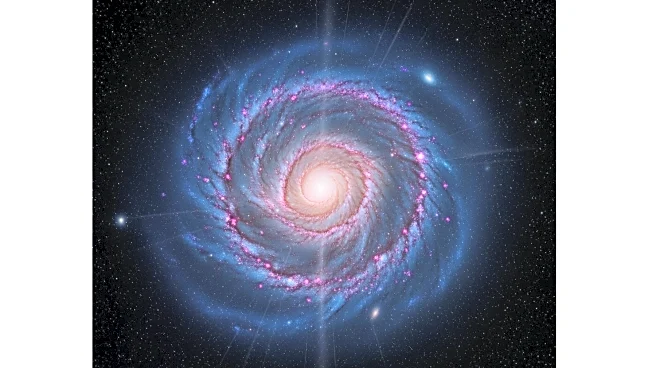

What's Happening?
NASA's Webb telescope has provided unprecedented images of the Circinus galaxy, offering new insights into the activity around its central supermassive black hole. Led by Dr. Enrique Lopez-Rodriguez, the team
used Aperture-Mask Interferometry to achieve high-resolution images of the galaxy's core. Contrary to previous beliefs that outflows of superheated matter were the primary source of infrared light, the new data suggests that most of the hot, dusty material is actually being accreted by the black hole. This discovery challenges existing theories about the dynamics of material around supermassive black holes.
Why It's Important?
These findings have significant implications for our understanding of galaxy formation and evolution. By revealing the processes occurring near supermassive black holes, scientists can better comprehend how these massive objects influence their host galaxies. The ability to observe such details also demonstrates the advanced capabilities of the Webb telescope, which is expected to drive further breakthroughs in astrophysics. This research could lead to revised models of black hole behavior and their role in the cosmic environment, impacting theories on the lifecycle of galaxies.
What's Next?
The Webb telescope will continue to explore other galaxies, potentially uncovering similar phenomena and further refining our understanding of the universe. Future observations may focus on comparing different galaxies to determine if the Circinus findings are unique or part of a broader pattern. The data collected will also contribute to ongoing efforts to map the universe's structure and the role of black holes in shaping it. As more discoveries are made, they will likely influence both theoretical and observational astrophysics.