



What's Happening?
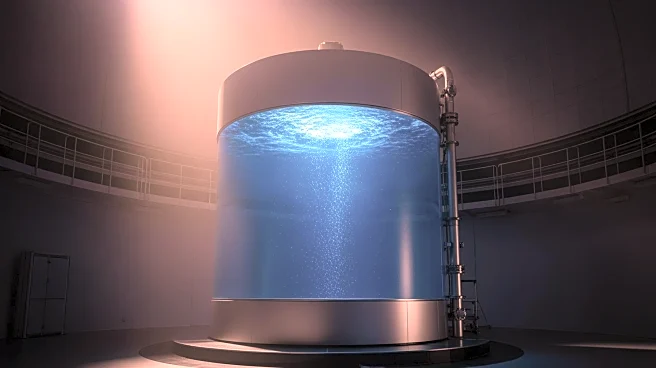
Physicists in Japan have enhanced the capabilities of the Super-Kamiokande neutrino detector by adding gadolinium sulfate to its 50,000-ton water volume. This upgrade allows the detector to capture neutrons released during neutrino interactions, which
are then absorbed by gadolinium, producing gamma rays that provide a clear signature of neutrino events. This improvement makes Super-Kamiokande one of the most sensitive instruments for observing solar neutrinos, enabling unprecedented precision in studying the nuclear processes of the Sun. The upgrade builds on previous detections, such as the 2020 observation of CNO neutrinos at the Borexino detector in Italy, which are produced during the carbon-nitrogen-oxygen cycle in the Sun.
Why It's Important?
The upgrade to the Super-Kamiokande detector represents a significant advancement in the field of neutrino physics, offering new insights into the nuclear reactions occurring within the Sun. This enhanced sensitivity allows scientists to test and refine models of solar energy production, which has implications for our understanding of stellar processes and the fundamental forces of nature. The ability to detect and analyze solar neutrinos with greater accuracy could lead to breakthroughs in astrophysics and particle physics, potentially resolving longstanding questions about the Sun's behavior and the universe's fundamental properties.