






What's Happening?
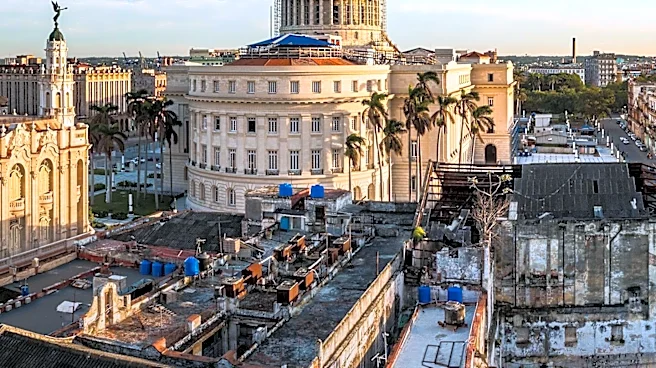
On November 2, Cuba enacted Law 186, which reduces its central state apparatus from 27 bodies to 21, comprising 20 ministries and the Central Bank. This new structure became effective on November 9. The government has granted the ministries up to one
year to redistribute staff, funds, property, and functions. The National Assembly approved this law on July 30. This reorganization aims to streamline bureaucracy, integrate related functions, and potentially cut administrative costs. For instance, functions related to agriculture, sugar, fishing, and the food industry have been merged into one ministry, and economic planning, state finance, budgets, prices, taxes, and investment policy are now under a single entity. Similarly, environment, housing, urban planning, and water systems are to be managed together. Ministers are required to submit work timetables for these mergers to Prime Minister Manuel Marrero by December 9.
Why It's Important?
This governmental restructuring in Cuba is significant as it represents an attempt to address long-standing issues of administrative inefficiency and economic challenges. By consolidating ministries, the Cuban government aims to improve coordination and potentially make public management more responsive to citizen needs, particularly in critical areas like food supply, housing, and infrastructure. The integration of foreign investment policy under a single Ministry of Commerce and Foreign Investment could also signal an effort to create a more coherent and perhaps more attractive environment for international businesses, although the source notes that this change does not alter existing U.S. sanctions. The reform is presented as a rationalization effort in a country facing shortages of money, fuel, and labor, and could impact how resources are allocated and how quickly administrative processes are completed.
What's Next?
Cuban ministries have up to one year from November 9 to complete the redistribution of staff, funds, and functions according to Law 186. Ministers must submit their work timetables to Prime Minister Manuel Marrero by December 9. The appointments of new officials within the consolidated ministries will indicate the depth and direction of these mergers. The government's stated goal is to improve efficiency and coordination, but the actual impact on public services and economic conditions remains to be seen. The law also includes the Ministry of Information and Social Communication among the 20 ministries, which could influence how official communications and media are managed. The process of dismantling and reassembling government bodies will occur amidst ongoing national economic challenges.
Beyond the Headlines
While the official narrative frames this reorganization as a move towards greater efficiency and rationalization, deeper implications suggest a continued emphasis on centralized control. The source points out that while the government is compressing the apparatus that fails to deliver, it is simultaneously preserving, and in some respects upgrading, the apparatus that explains away failure. The inclusion of the Ministry of Information and Social Communication at a ministerial level suggests a continued focus on managing the national narrative. Critics argue that true institutional repair requires transparency and accountability, which may not be achieved simply by rearranging administrative structures. The law's silence on the fate of individual employees as offices merge or vanish, especially after previous announcements of job eliminations in other sectors, could lead to uncertainty among the workforce. This reform occurs in a context where the state is poorer and the country more depleted, raising questions about the effectiveness of administrative changes without fundamental shifts in political and economic freedoms.