


What's Happening?
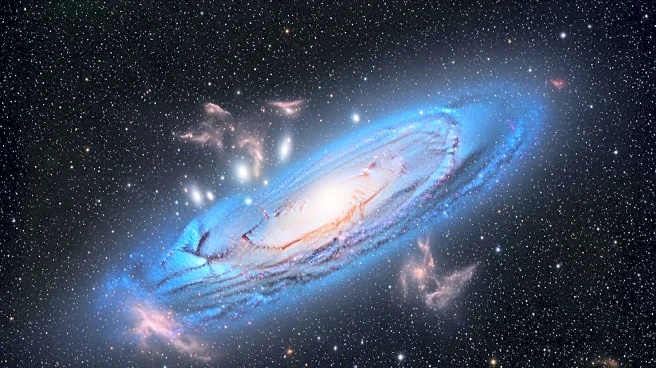
The Andromeda Galaxy, also known as M31, is a prominent feature in the northern sky and is the nearest large spiral galaxy to the Milky Way. It is located in the constellation Andromeda and is part of the Local Group of galaxies. Historically, the galaxy has
been observed and described by astronomers since 964, with significant contributions from figures like Persian astronomer Abdal-Rahman Al-Sufi and German astronomer Simon Marius. The galaxy was cataloged by Charles Messier in 1764 and photographed for its spiral structure by Isaac Roberts in 1888. American astronomer Vesto M. Slipher measured its radial velocity in 1912, and Edwin Hubble confirmed its extragalactic nature in 1923. The Andromeda Galaxy is visible to the naked eye under clear, dark skies and can be observed in detail using telescopes, revealing its nucleus, dust lanes, and companion galaxies.
Why It's Important?
The Andromeda Galaxy is a critical object of study for astronomers due to its proximity and similarity to the Milky Way. Observing M31 provides insights into the structure and dynamics of spiral galaxies, which are common in the universe. The historical observations and measurements of Andromeda have contributed significantly to our understanding of galaxies beyond the Milky Way, helping to establish the concept of an expanding universe. For amateur astronomers, Andromeda offers a unique opportunity to observe a galaxy in detail, enhancing public interest and engagement in astronomy. The galaxy's visibility and accessibility make it a popular target for both professional and amateur astronomers, fostering a deeper appreciation for cosmic phenomena.
What's Next?
As technology advances, astronomers will continue to study the Andromeda Galaxy using more sophisticated instruments, potentially uncovering new details about its structure and behavior. Future observations may focus on its star-forming regions, spiral arms, and interactions with its companion galaxies. Additionally, as the Milky Way and Andromeda are on a collision course, studying M31 can provide valuable information about the future dynamics of our own galaxy. Public and educational outreach programs may use Andromeda as a focal point to inspire interest in astronomy and science, leveraging its visibility and historical significance.
Beyond the Headlines
The Andromeda Galaxy's study has broader implications for understanding galaxy formation and evolution. Its proximity allows astronomers to test theories about spiral galaxy dynamics and star formation processes. The historical context of its observation highlights the evolution of astronomical techniques and the growing understanding of the universe. As a cultural icon, Andromeda also represents humanity's quest for knowledge and exploration beyond our planet, symbolizing the interconnectedness of science, history, and culture.