



What's Happening?
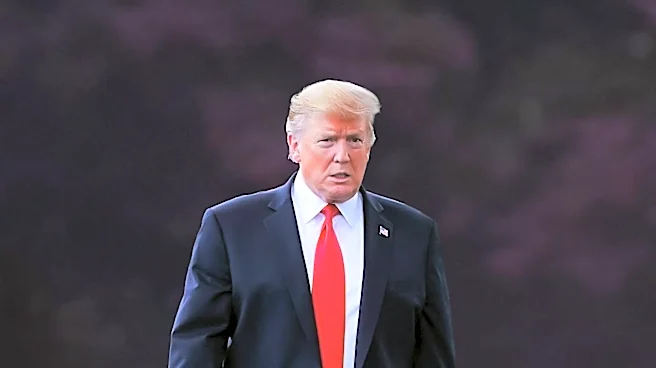
New York Times journalist Maggie Haberman has firmly rejected President Trump's repeated assertion that his administration is the 'most transparent of all time.' During an interview, Haberman characterized this claim as merely a 'display of transparency,
a spectacle of transparency.' She noted that the White House is 'very good at keeping secrets,' not only when it chooses to but also for reasons that may not serve the public interest. Haberman cited examples such as President Trump's 'self-enrichment' during his return to office, the controversy surrounding a decoy airplane, and questions about his health as instances of a lack of transparency. She concluded that, objectively, the Trump administration is 'incredibly nontransparent' and that this tone originates from the president himself.
Why It's Important?
Maggie Haberman's dismissal of President Trump's transparency claims is significant because it comes from a seasoned journalist who has extensively covered his administration. Her perspective challenges a core narrative often promoted by President Trump and his allies, directly impacting public perception of government accountability and openness. This critique highlights the ongoing tension between political rhetoric and journalistic scrutiny, particularly concerning the executive branch's operations. For the public, it underscores the importance of independent media in evaluating official claims and holding power accountable. The discussion also brings to light the broader issue of 'gaslighting' in politics, where repeated assertions, even if contradicted by evidence, can influence public opinion and trust in institutions. This dynamic is crucial for a healthy democracy, as transparency is often considered a cornerstone of good governance.
What's Next?
This commentary by Maggie Haberman is likely to fuel ongoing debates about the transparency of government operations and the role of the media in scrutinizing political claims. It may prompt further discussions among journalists, political analysts, and the public regarding the standards of transparency expected from public officials. President Trump or his supporters may respond to Haberman's remarks, potentially escalating the exchange and reinforcing existing divisions over media credibility. The broader implications could include increased public demand for greater government transparency and a continued focus on the methods and effectiveness of journalistic oversight in an era of heightened political polarization.
Beyond the Headlines
Haberman's characterization of President Trump's transparency claims as a 'spectacle' delves into the deeper implications of political communication in the digital age. It suggests that transparency can sometimes be performative, designed to create an impression rather than to genuinely inform the public. This raises critical questions about the nature of political discourse, where the presentation of information can be as important as the information itself. The concept of 'gaslighting' in politics, as alluded to in the interview, highlights how persistent, contradictory narratives can sow doubt and confusion, making it difficult for citizens to discern truth from falsehood. This phenomenon has profound effects on civic engagement, trust in institutions, and the ability of a democratic society to make informed decisions, pointing to a long-term shift in how political leaders interact with both the media and the public.