





What's Happening?
The Swedish Official Non-Negotiating Delegation to COP31 has outlined five implementation priorities aimed at making Nationally Determined Contributions (NDCs) investable. These priorities, developed from a roundtable hosted by Business Sweden during
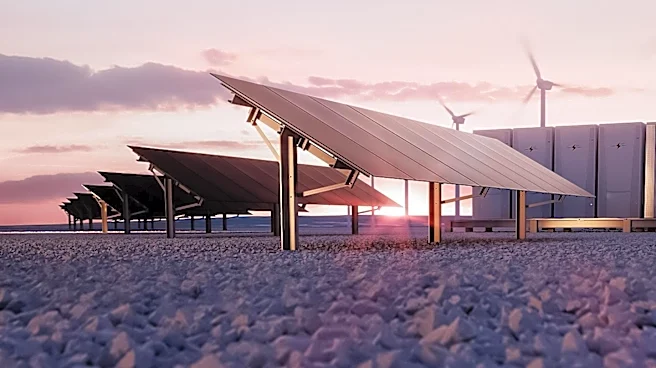
Climate Week New York 2026, focus on accelerating investment and deployment of climate solutions globally. The key areas include scaling electrification through integrated delivery packages, creating lead markets for low-carbon industrial products, treating energy efficiency as an infrastructure priority, building integrated heavy-duty transport corridors, and matching finance to specific barriers. The delegation, comprising representatives from Swedish businesses, government agencies, and organizations, emphasizes the need for alignment between demand, infrastructure, project portfolios, finance, technology, and delivery partners to overcome barriers like weak demand signals, policy uncertainty, and infrastructure bottlenecks.
Why It's Important?
This initiative is crucial for translating global climate commitments into tangible actions and investments. NDCs, while setting national targets, often lack the detailed pathways and financial mechanisms to attract necessary capital. By proposing concrete implementation priorities, the Swedish delegation aims to provide markets with clear signals, thereby de-risking investments and accelerating the deployment of clean technologies. The focus on integrated approaches—connecting clean generation, grids, storage, industrial conversion, and transport—addresses the systemic nature of the energy transition. Furthermore, the emphasis on creating lead markets for low-carbon industrial products and treating energy efficiency as an infrastructure priority highlights innovative strategies to drive demand and optimize resource use, which are vital for achieving deep decarbonization across various sectors. This framework could serve as a model for other nations and international bodies seeking to operationalize their climate goals.
What's Next?
The COP31 Presidency is encouraged to advance these five implementation priorities through negotiations and delivery packages on electrification and green industrialization. The delegation also suggests mapping existing initiatives to avoid duplication and reporting progress on these priorities for consideration at COP32. Swedish companies, with their expertise in advanced grids, industrial electrification, decarbonized steel, and energy efficiency, are prepared to support project development, financing partnerships, and technology deployment adapted to country priorities. The ongoing dialogue at COP31 and subsequent climate conferences will likely focus on how to integrate these priorities into national roadmaps and international cooperation frameworks, ensuring that finance is fit-for-purpose and addresses specific barriers to project implementation. The goal is to build power to confront power, challenging entrenched interests and redirecting capital towards sustainable solutions.
Beyond the Headlines
The Swedish delegation's proposal goes beyond conventional climate policy by emphasizing the critical role of market signals, integrated planning, and targeted finance in achieving climate goals. By advocating for predictable carbon pricing, public procurement, and long-term offtake agreements for green products, they aim to create a stable investment environment that rewards early movers and drives industrial decarbonization. The inclusion of energy efficiency as an infrastructure priority reflects a holistic understanding of resource management, recognizing its potential to reduce overall infrastructure needs and strengthen resilience. This approach also highlights the importance of international collaboration and the sharing of best practices, particularly from countries with advanced clean energy technologies. Ultimately, these priorities seek to ensure that the energy transition is not just about replacing one energy system with another, but about building a genuinely more just and sustainable global economy, with a focus on who controls resources and who benefits from the transition.