




What's Happening?
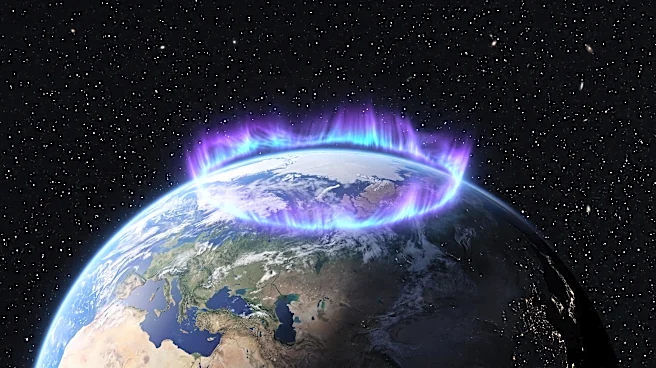
The Solar Wind Magnetosphere Ionosphere Link Explorer (SMILE), a joint mission between the European Space Agency (ESA) and the Chinese Academy of Sciences (CAS), has captured footage revealing the full ring of auroral activity encircling Earth's north
pole in ultraviolet light. This footage, taken on July 24, shows auroras glowing on Earth's dayside, an activity typically obscured by the sun's glare. The spacecraft's Ultraviolet Imager (UVI), which was activated two weeks prior to the capture, is the first camera since NASA's Polar spacecraft in 2008 capable of imaging the entire northern auroral oval in ultraviolet light. SMILE's primary objective is to investigate how Earth responds to solar wind, the continuous stream of charged particles from the sun. Auroras are formed when these energized particles collide with gases in Earth's atmosphere, a process that begins with the interaction of solar wind with Earth's magnetosphere.
Why It's Important?
This development is significant for space weather research and understanding Earth's interaction with the sun. By observing the entire auroral oval simultaneously, SMILE provides scientists with a comprehensive view of the magnetosphere's connection to auroral activity. The ability of the ultraviolet imager to continuously observe these phenomena for up to 45 hours at a time allows researchers to track how the auroral oval changes in response to varying solar wind conditions. This continuous, wide-angle observation offers a new window into studying the movement of energetic particles from the sun through Earth's magnetic environment, which ultimately causes the northern lights. Improved understanding of these processes can lead to better predictions and mitigation strategies for space weather events that can impact U.S. infrastructure, including satellites, communication systems, and power grids.
What's Next?
The initial footage from SMILE's UVI instrument offers a promising glimpse into the scientific data expected from the mission. Combined with data from SMILE's other instruments, these observations will continue to provide scientists with detailed insights into the dynamics of Earth's magnetosphere and its response to solar wind. Researchers will analyze the long-duration observations to identify patterns and correlations between solar wind changes and auroral activity. This ongoing data collection and analysis will contribute to a more complete picture of space weather phenomena, potentially leading to advancements in space weather forecasting and a deeper understanding of fundamental plasma physics in Earth's vicinity. The mission is expected to continue providing valuable data for an extended period, building upon this initial success.
Beyond the Headlines
The SMILE mission's success in imaging daytime auroras highlights the evolving capabilities in space observation and the increasing international collaboration in scientific endeavors. The ability to observe auroras from a new perspective, beyond the limitations of Earth-based viewing, underscores the importance of satellite-based instrumentation for comprehensive scientific understanding. This mission also subtly emphasizes the interconnectedness of celestial phenomena and their direct impact on Earth. The insights gained from SMILE could have long-term implications for understanding planetary magnetospheres beyond Earth, potentially informing future missions to other planets with magnetic fields. Furthermore, the technological advancements in ultraviolet imaging demonstrated by UVI could pave the way for new instruments and observational techniques in future space exploration and research.