
What's Happening?
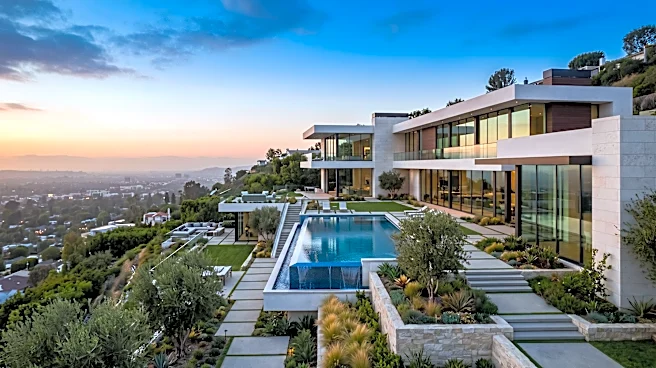
In several Los Angeles-area neighborhoods, the ultrarich are initiating a trend dubbed 'mansionization,' which involves purchasing existing luxury homes, demolishing them, and constructing significantly
larger, more extravagant properties. This phenomenon is leading to the displacement of even wealthy residents as older, albeit still substantial, homes are replaced by mega-mansions. For instance, a one-story, three-bedroom house at 1360 Laurel Way in Beverly Hills was razed in 2023 to make way for a three-story mansion featuring waterfalls, a 20-car garage, and a penthouse pickleball court, now listed for $53 million. This trend is fueled by a growing demand for exclusive Los Angeles addresses from newly minted tech millionaires and wealthy international families, according to luxury developer Ramtin Ray Nosrati. Demolitions in Los Angeles peaked in 2018, with the Westside's share of these demolitions increasing from approximately 1 in 10 in 2018 to nearly 1 in 4 last year, as reported by Crosstown L.A. data. The number of properties valued over $25 million in seven Westside communities has surged from 59 a decade ago to over 300 today, indicating significant building replacement rather than just price appreciation.
Why It's Important?
This 'mansionization' trend in Los Angeles signifies a unique form of gentrification, where the ultrarich are displacing the rich, rather than lower-income residents. This has several important implications. Firstly, it exacerbates land scarcity in prime locations, driving up property values to unprecedented levels and making even high-end homes inaccessible to many wealthy individuals. Secondly, it alters the architectural landscape of established affluent neighborhoods, replacing homes that some architectural historians consider noteworthy with modern, often oversized, structures. Conservationists are finding it difficult to preserve examples of Los Angeles's past against this wave of redevelopment. Thirdly, the practice of tearing down existing homes to build larger ones, often without a buyer secured, indicates a speculative development market that, while sometimes highly profitable, also carries significant risks, as evidenced by a developer who lost a $500 million project in a bankruptcy auction. This trend also highlights the increasing wealth disparity, as the ultrarich remain unaffected by high mortgage rates and property prices that impact most of the country.
What's Next?
The trend of 'mansionization' in Los Angeles is expected to continue, with developers actively seeking properties in prestigious neighborhoods for redevelopment. The process of demolishing existing homes to build larger ones is often favored because it reduces the likelihood of costly permit delays or rejections, as established zoning and existing environmental surveys and utilities streamline the construction process. This approach is seen as less risky than developing on vacant land, which requires initial approvals. Neighborhood associations, such as the Beverly Grove Neighborhood Assn., have attempted to amend development requirements to limit the impact of new properties on existing residents, citing concerns about ecological damage and crowded streets. However, these efforts are often outgunned by developers who are adept at finding loopholes in building codes. While some residents are happy to see property prices skyrocket, others are exploring options like historic preservation zones, though this strategy has its own drawbacks, including potential impacts on property values and lengthy approval processes. Therefore, the bulldozing for large-scale builds by billionaires is anticipated to persist.
Beyond the Headlines
The 'mansionization' phenomenon in Los Angeles raises deeper questions about urban development, wealth concentration, and the definition of community. Ethically, it prompts a discussion on whether the pursuit of extreme luxury in housing should override the preservation of architectural heritage or the character of established neighborhoods. The legal framework, particularly building codes and zoning regulations, appears to be struggling to keep pace with the rapid and aggressive redevelopment strategies employed by ultrarich developers. The cultural implications are also significant, as the influx of 'new money' reshapes the aesthetic and social fabric of historically affluent areas. This trend could lead to a more homogenous, hyper-luxurious urban landscape, potentially eroding the unique identities of these neighborhoods. Furthermore, it underscores a growing divide where even the 'rich' are being priced out or overshadowed by the 'ultrarich,' suggesting a new frontier in economic stratification within the housing market. The long-term shift could see Los Angeles's most desirable enclaves becoming exclusive playgrounds for a global elite, further detaching them from the broader urban context.