
What's Happening?
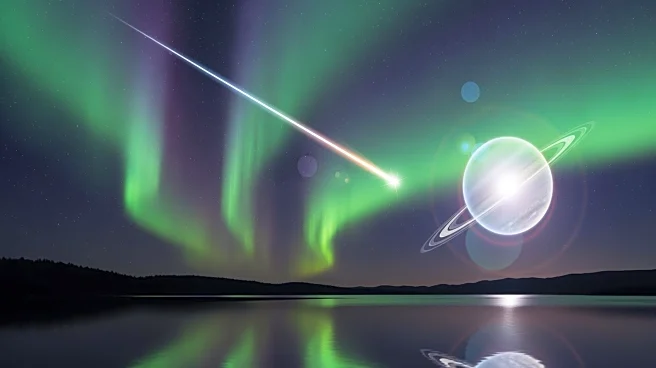
On December 22, 2025, the night sky offers a spectacular view with the peak of the Ursid meteor shower, a minor geomagnetic storm boosting aurora visibility, and bright planets like Jupiter and Saturn
dominating the sky. The Ursid meteor shower, caused by debris from Comet 8P/Tuttle, is expected to display 5-10 meteors per hour under dark skies. The National Oceanic and Atmospheric Administration (NOAA) forecasts minor geomagnetic storming, which could enhance aurora visibility beyond the polar regions. Additionally, Jupiter and Saturn are prominent in the night sky, with Jupiter visible for most of the night and Saturn best seen in the early evening.
Why It's Important?
This celestial event is significant for both amateur astronomers and the general public, offering a rare opportunity to witness multiple astronomical phenomena simultaneously. The meteor shower and auroras provide a natural spectacle that can inspire interest in astronomy and science. The visibility of bright planets like Jupiter and Saturn adds educational value, allowing observers to learn more about our solar system. Such events can also boost local tourism in areas known for dark skies, as people travel to witness these natural wonders.
What's Next?
Following the Ursid meteor shower, skywatchers can look forward to Jupiter reaching opposition in early January 2026, when it will be visible all night and at its brightest for the year. The Quadrantid meteor shower is also expected to peak in early January, although moonlight may interfere with visibility. These upcoming events continue to offer opportunities for astronomical observation and public engagement with science.
Beyond the Headlines
The increasing interest in night sky events highlights a growing trend in dark-sky tourism, where regions with minimal light pollution attract visitors seeking unobstructed views of celestial phenomena. This trend underscores the importance of preserving dark skies and reducing light pollution to maintain these natural experiences. Additionally, the coordination of space weather forecasts and astronomical observations reflects the integration of science and technology in enhancing public understanding and appreciation of the universe.