



What's Happening?
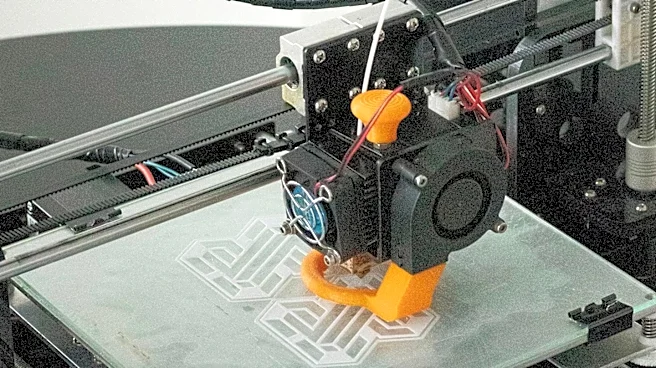
A new 3D printing technique called 'wave overhangs' is being developed to allow for the printing of horizontal overhangs without the need for traditional support structures. This method builds upon existing techniques like arc overhangs, but aims to overcome
their limitations, such as dimples at the center of each arc. The core idea is to instruct the slicer software to 'grow' the overhang from the main part of the print, rather than attempting to print it in free space. For example, when printing a 'T' shape vertically, the arms of the 'T' can be printed by starting them with slight overlapping from the stem, allowing them to extend by hanging onto the previously printed line. This approach replaces the arc-based method with a wave-like pattern, similar to how waves diffract around obstacles in water, enabling more complex overhangs.
Why It's Important?
The development of 'wave overhangs' could significantly impact the 3D printing industry by reducing material waste and post-processing time. Traditional support structures consume extra filament and often require manual removal, which can be labor-intensive and sometimes damage the printed object's surface. By eliminating or minimizing the need for supports, this new technique offers a more efficient and cost-effective printing process. This innovation could make 3D printing more accessible and appealing for a wider range of applications, from rapid prototyping to end-use parts, particularly for designs with intricate overhangs. For businesses, this means faster production cycles and lower operational costs. For individual users, it translates to less frustration and more successful prints, potentially fostering greater adoption of 3D printing technology across various sectors.
What's Next?
While 'wave overhangs' show promise, researchers are still experimenting with optimal settings, as there have been reports of increased warping. The next steps involve further refinement of the technique and its integration into 3D printer slicer software. Users interested in experimenting with this method can download a fork of Orca, a popular slicer, to contribute their results and feedback to the community. Continued research will focus on mitigating issues like warping and optimizing the wave patterns for different geometries and materials. If successful, this technique could become a standard feature in future 3D printing software, leading to widespread adoption. The community's involvement in testing and providing feedback will be crucial for its development and eventual commercial implementation, potentially leading to new design possibilities for 3D printed objects.
Beyond the Headlines
The innovation of 'wave overhangs' represents a deeper shift in how 3D printing challenges are approached, moving towards more intelligent and material-efficient solutions. It highlights the ongoing evolution of additive manufacturing, where software algorithms play an increasingly critical role in optimizing physical production processes. This technique could inspire further research into 'self-supporting' geometries and advanced slicing algorithms that mimic natural growth patterns or physical phenomena. Ethically, reducing material waste aligns with broader sustainability goals in manufacturing. Legally, the open-source nature of some of these developments, like the Orca fork, fosters collaborative innovation and knowledge sharing within the tech community. Culturally, such advancements push the boundaries of what is considered printable, potentially leading to new artistic and functional designs that were previously impractical or impossible to achieve with conventional 3D printing methods.