





What's Happening?
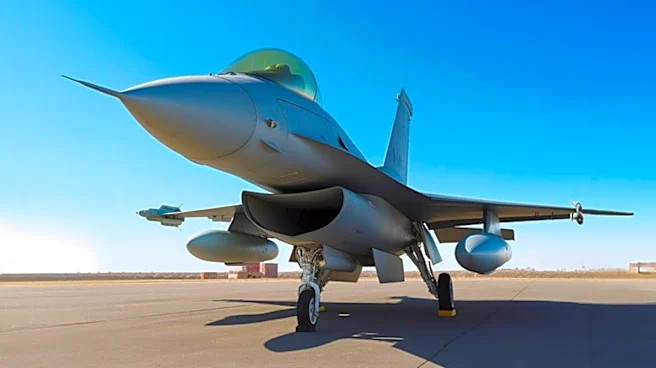
NATO Allies are significantly investing in F-35 Lightning jets, with plans for over 700 F-35s in European flight lines by 2028. This procurement aims to establish a technological edge in air combat. However, this focus on advanced airframes is accompanied
by a systematic underinvestment in crucial terrestrial infrastructure. This includes base hardening, counter-drone defenses, resilient networks, and ground crews. Experts warn that an F-35 without adequate ground support, fuel, parts, or secure command links becomes an expensive target rather than a deterrent. The current strategy overlooks the importance of operational endurance, which is generated on the ground, and could leave the F-35 fleet vulnerable to a coordinated 'Day Zero' assault, similar to historical events where air forces were destroyed on the ramp. Recent innovations, such as the use of commercial-style drones for deep strikes, further highlight the vulnerability of unhardened rear sanctuaries.
Why It's Important?
This underinvestment poses a significant risk to NATO's air power and overall defense strategy in Europe, particularly in the context of potential conflict with Russia. The F-35's advanced capabilities are heavily reliant on robust ground support and secure infrastructure. Without these, the jets' effectiveness could be severely compromised, turning them into liabilities rather than assets. A 'Day Zero' scenario, involving standoff salvos, covert drone launches, sabotage, and electromagnetic disruption, could cripple NATO's airbases before any formal declaration of Article 5. This situation could lead to a rapid loss of air superiority, undermining deterrence and leaving European skies vulnerable. The reliance on a single, sophisticated system without adequate foundational support creates a critical vulnerability that could be exploited by adversaries, impacting regional stability and the security of NATO member states.
What's Next?
To address these vulnerabilities, NATO member states must rebalance their defense spending to prioritize systemic survivability alongside platform acquisition. This includes institutionalizing dispersal and Agile Combat Employment (ACE) practices, hardening perimeters and flight lines with point-defense systems and rapid airfield damage repair kits, and expanding logistics at strategic depth. Furthermore, there is a critical need to solve cross-domain data mesh challenges to ensure resilient, jam-resistant data architectures and mission command protocols in degraded environments. Re-arming and retraining ground crews with specialized force-protection capabilities and cross-training for austere, contested conditions are also essential. These measures are necessary to build credible deterrence by denial, ensuring NATO's ability to absorb a first strike and generate combat power under fire through realistic, high-tempo exercises.
Beyond the Headlines
The current situation highlights a broader strategic challenge in modern warfare: the increasing importance of resilient infrastructure and logistical support in an era of advanced technology. The 'F-35 Fallacy' underscores that even the most sophisticated military hardware is only as effective as the ecosystem that supports it. This extends beyond military implications to economic and societal ones, as the cost of replacing or repairing damaged infrastructure and aircraft in a conflict scenario would be immense. The emphasis on 'unglamorous terrestrial infrastructure' suggests a need for a more holistic approach to defense planning, one that integrates technological superiority with robust foundational capabilities. This shift in perspective is crucial for maintaining long-term security and stability, as it acknowledges that future conflicts may not be won solely through advanced weaponry but also through the resilience and adaptability of supporting systems.