
What's Happening?
The U.S. Department of Energy (DoE) has announced a significant investment of $5.25 billion, which includes $1.9 billion in federal funds and $3.35 billion in cost-share funding, to support numerous grid
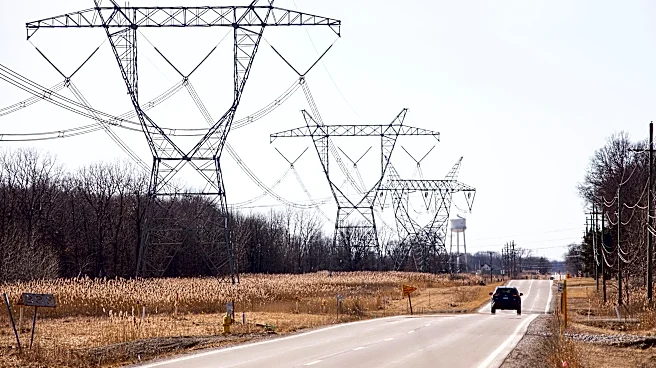
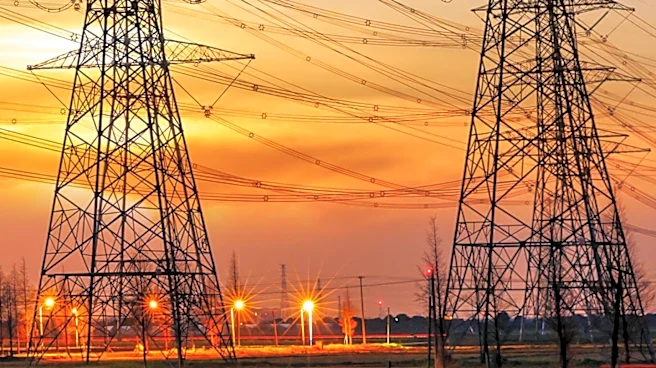
improvement projects across the nation. This initiative, part of the Speed to Power through Accelerated Reconductoring and other Key Advanced Transmission Technology Upgrades (SPARK) program, aims to unlock an additional 23 gigawatts of electrical capacity. The funding, made available under the Grid Resilience and Innovation Partnerships (GRIP) program, will be distributed across 31 specific projects in 26 states. These projects will focus on reconductoring or rebuilding over 1,500 miles of transmission lines and deploying grid-enhancing technologies (GETs) such as sensors, power flow control devices, and analytical tools across 21,000 miles of American grid infrastructure. The DoE states that these investments are designed to improve reliability and lower electricity costs for approximately 100 million Americans, while also enhancing grid resilience and mitigating wildfire risks in prone areas.
Why It's Important?
This substantial investment in grid infrastructure is crucial for the U.S. economy and its growing energy demands, particularly from the rapidly expanding data center industry. Financial services firm Moody’s recently warned that the pace of data center construction is outstripping the grid's capacity to add necessary power. By 2030, U.S. data center electricity consumption is projected to reach 426 TWh, nearly double the 2025 figure. The DoE's program directly addresses this power constraint by increasing the efficiency and capacity of existing infrastructure rather than solely focusing on new power generation. This approach is vital for supporting the artificial intelligence (AI) boom, which heavily relies on data centers. Improved grid reliability and lower electricity costs will benefit both consumers and businesses, fostering economic stability and growth. The focus on resilience and wildfire mitigation also protects critical infrastructure and communities from the increasing threats of natural disasters, ensuring a more stable energy supply for various sectors.
What's Next?
The 31 projects across 26 states are expected to commence, focusing on the implementation of reconductoring efforts and the deployment of grid-enhancing technologies. The DoE will likely monitor the progress and effectiveness of these projects in unlocking the promised 23 gigawatts of additional capacity. There may be continued discussions and investments in alternative energy technologies, such as small modular reactors, geothermal generation, and the recommissioning of aging nuclear plants, to further address the long-term energy demands, especially from the data center sector. Chipmakers like Nvidia are also expected to continue their efforts in developing more efficient data centers that can manage and release capacity back to the grid, complementing the infrastructure upgrades. The success of these initiatives will be critical in determining future policy and investment strategies for U.S. energy infrastructure.
Beyond the Headlines
The DoE's strategy of enhancing existing grid infrastructure rather than solely building new power plants highlights a shift towards optimizing current resources, which has significant environmental and economic implications. By improving efficiency and reliability, the program could reduce the need for new, potentially carbon-intensive power generation, aligning with broader climate goals. The integration of advanced technologies like sensors and analytical tools represents a move towards a 'smarter' grid, capable of dynamic management and quicker response to demand fluctuations and outages. This technological advancement could set a precedent for future infrastructure projects, emphasizing innovation and data-driven decision-making. Furthermore, the program's focus on supporting the energy needs of data centers underscores the increasing interdependence between digital infrastructure and traditional energy systems, raising questions about the long-term sustainability and energy footprint of the digital economy.