




What's Happening?
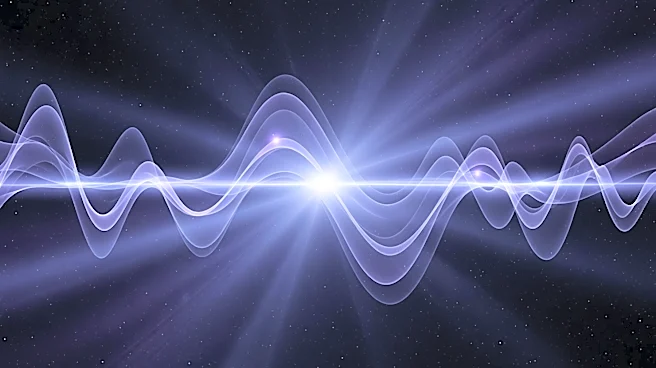
A new study by Professor Joachim Kopp from Johannes Gutenberg University Mainz and Dr. Azadeh Maleknejad from Swansea University suggests that gravitational waves could be responsible for the production of dark matter during the early universe. Their
research, published in Physical Review Letters, explores a novel mechanism where stochastic gravitational waves, which are weaker and form part of the universe's background noise, may have contributed to the formation of dark matter particles. This theory provides a new perspective on the origins of dark matter, which constitutes about 23% of the universe.
Why It's Important?
Understanding the origins of dark matter is crucial for comprehending the universe's composition and evolution. This study offers a potential explanation for the formation of dark matter, which remains one of the most significant unsolved mysteries in physics. If gravitational waves are indeed linked to dark matter production, it could revolutionize current theories and lead to new research directions in particle physics and cosmology. This could also impact the development of future experiments aimed at detecting dark matter particles.
What's Next?
The researchers plan to conduct numerical calculations to improve the accuracy of their predictions and explore further effects of gravitational waves in the early universe. This includes investigating mechanisms that could explain the observed imbalance between particles and antiparticles. Continued research in this area could provide deeper insights into the fundamental forces and particles that govern the universe.