







What's Happening?
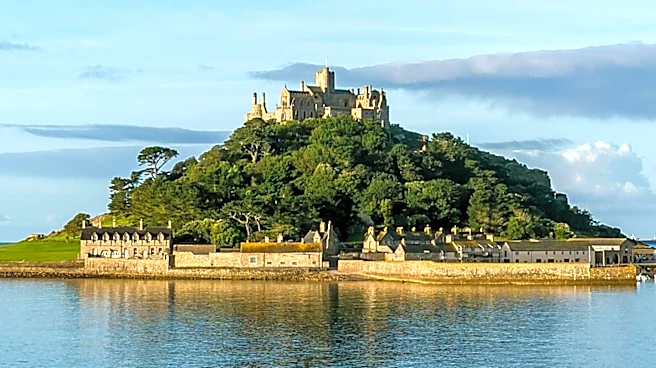
A new project in Cornwall, inspired by the Eden Project's co-founder Jonathan Ball, seeks to transform rural churches into 'Memory Palaces.' This initiative aims to repurpose these historic sacred spaces into centers of heritage, encounter, and community,
rather than just accommodation or community centers. The concept draws from the ancient rhetorical technique of 'ars memoriae' or 'method of loci,' where architecture was used to aid memory. The pilot program, with a working title of 'From Hawker to Hardy,' intends to integrate churches like Morwenstow and St Juliot's, creating a pilgrimage experience where visitors can engage with history, literature, faith, landscape, and community. Volunteers will be trained to share the stories of these churches and their settings, including saints and local people. The project emphasizes the 'genius loci,' or guardian spirit of a place, believing that the north Cornwall landscape teaches attentiveness, humility, and continuity, viewing it as an inheritance.
Why It's Important?
This project is important because it addresses the challenge of declining church congregations and disconnected communities in rural areas. By transforming these spaces into 'Memory Palaces,' it seeks to breathe new life into emptying churches and foster a sense of belonging and shared identity. The initiative could serve as a model for other regions facing similar issues, offering a way to preserve historical sites while making them relevant to contemporary needs. It highlights the value of local heritage and the potential for cultural tourism to support rural economies. Furthermore, by focusing on wellbeing, story, welcome, reflection, and shared responsibility, the project aims to reconnect individuals with their collective past and with each other, counteracting the atomizing effects of modern life. It underscores the idea that physical places can serve as powerful anchors for memory and community.
What's Next?
The pilot program, 'From Hawker to Hardy,' is expected to move forward with the transformation of selected rural churches in north Cornwall. The project will involve training volunteers to guide visitors and share the rich history and stories associated with these sites. Community engagement will be crucial for the success of this initiative, as it relies on local participation and support. The project's progress will likely be monitored to assess its effectiveness in attracting visitors, fostering community connections, and preserving heritage. If successful, this model could be expanded to other churches and historical sites within Cornwall and potentially inspire similar initiatives in other regions. The project aims to demonstrate how historical spaces can be revitalized to meet contemporary needs for connection and cultural understanding.
Beyond the Headlines
The 'Memory Palaces' project delves into deeper implications concerning the role of historical architecture in modern society and the preservation of collective memory. It suggests that in an increasingly digital and disconnected world, physical spaces imbued with history can offer a tangible link to our past and a foundation for community. The initiative implicitly critiques the tendency to view historical sites merely as relics, instead proposing an active, experiential engagement with them. It also touches upon the ethical responsibility of preserving cultural heritage in a way that is meaningful and accessible to current and future generations. By emphasizing the 'genius loci,' the project promotes a holistic understanding of place, where landscape, history, memory, faith, and community are intertwined, offering a counter-narrative to the commodification of heritage and the erosion of local identity.