



What's Happening?
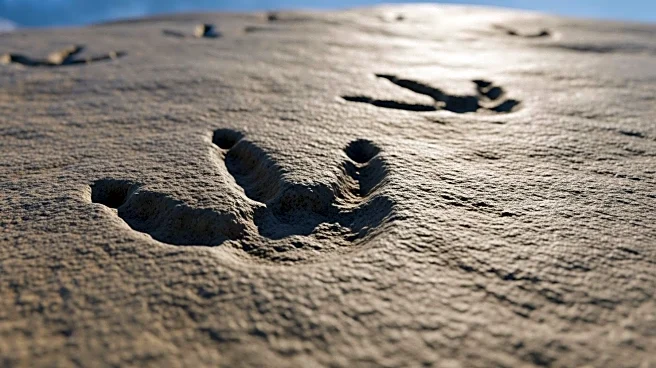
The Milan Natural History Museum has announced the discovery of thousands of dinosaur footprints in the central Alps of northern Italy, near the site of the upcoming 2026 Winter Olympics. These tracks, found in the Stelvio National Park, date back approximately
210 million years to the Late Triassic period. The footprints, primarily from herbivorous prosauropods, were discovered by nature photographer Elio Della Ferrara on dolomite walls. Due to the inaccessibility of the site, further studies will be conducted using drones and remote sensing technologies. This discovery marks the first time dinosaur footprints have been found in Lombardy, north of the Insubric Line.
Why It's Important?
The discovery of these dinosaur footprints is significant for both paleontology and the upcoming Winter Olympics. Scientifically, it provides new insights into the distribution and behavior of dinosaurs in the Late Triassic period, particularly in regions previously unexplored for such fossils. For the Winter Olympics, the proximity of this discovery to the event's location adds a unique historical and educational dimension, potentially attracting additional interest and tourism. The use of advanced technologies like drones for studying the site also highlights the integration of modern methods in archaeological research.
What's Next?
Further analysis of the footprints will be conducted to gain deeper insights into the types of dinosaurs that roamed the area and their behaviors. The findings could lead to more detailed exhibitions or educational programs at the Milan Natural History Museum, potentially coinciding with the Winter Olympics to maximize public engagement. Additionally, the discovery may prompt further exploration in the region, possibly uncovering more prehistoric evidence.