
What's Happening?
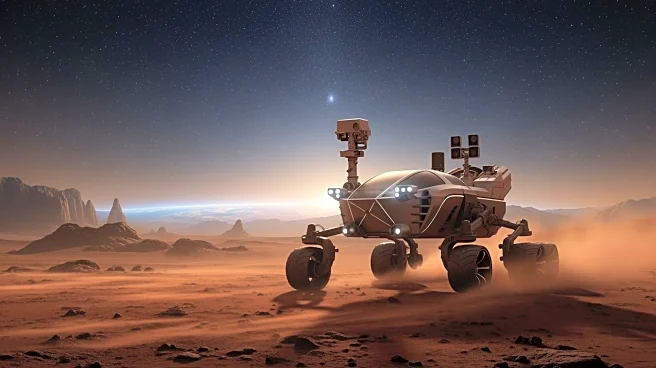
The Perseverance rover on Mars has recently celebrated significant milestones, marking five years of exploration on the Red Planet. Notably, it completed its first two drives entirely planned and executed by Artificial Intelligence (AI). Traditionally,
planning the daily movements of Mars rovers has been a complex task involving engineers, geologists, and data analysts. However, AI has been integrated into these operations, allowing the rover to autonomously navigate and execute tasks. This development is part of a broader trend where AI is increasingly used to handle tedious data processing tasks, such as sifting through vast collections of images from the Hubble Space Telescope. The AI system used by Perseverance was trained with extensive data, enabling it to recognize patterns and make logical decisions. This advancement allows the rover to undertake longer drives and identify significant scientific targets autonomously.
Why It's Important?
The integration of AI into Mars exploration represents a significant leap in space technology, potentially transforming how missions are conducted. By enabling rovers like Perseverance to operate more independently, AI reduces the need for constant human intervention, which is crucial given the communication delays between Earth and Mars. This autonomy not only enhances the efficiency of scientific exploration but also allows for more complex missions in the future. The success of AI-driven operations on Mars could pave the way for its application in other areas of space exploration, such as preparing landing sites and habitats for human missions. Moreover, the use of AI in space exploration highlights its broader potential in automating complex tasks across various industries, potentially leading to increased productivity and innovation.
What's Next?
As AI continues to prove its capabilities in space exploration, further tests and developments are expected. The success of AI-driven operations on Mars could lead to more autonomous missions, with AI taking on greater roles in navigation and data analysis. Future missions may involve AI-guided rovers and construction vehicles preparing for human exploration. Additionally, the lessons learned from AI applications in space could influence its use in other fields, encouraging the development of more sophisticated AI systems capable of handling complex tasks autonomously. Continued advancements in AI technology will likely lead to more efficient and effective exploration of Mars and beyond.