

What's Happening?
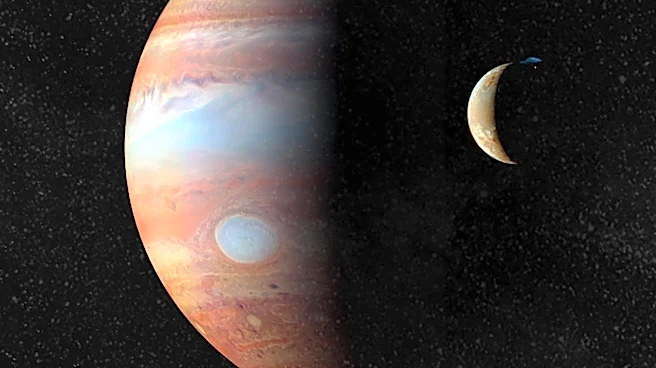
Jupiter's moon Io experiences extreme tidal forces from the gas giant, causing its solid ground to rise and fall by as much as 100 meters during each 42.5-hour orbit. This vertical displacement is comparable to the height of a 30-story building and is approximately
500 times greater than Earth's solid-ground tide. This constant flexing of Io's interior generates immense heat, making it the most volcanically active body in the Solar System. The gravitational gradient from Jupiter stretches Io along the line towards the planet and compresses it in other directions. While Io rotates synchronously, its slightly eccentric orbit, influenced by Europa and Ganymede, prevents the tidal bulge from remaining steady, ensuring continuous deformation and heating. This process converts orbital energy into heat, which is then released through Io's approximately 400 volcanoes, constantly resurfacing the moon.
Why It's Important?
The phenomenon on Io provides a unique natural laboratory for understanding tidal heating, a fundamental process that influences the geological activity and potential habitability of many moons in our solar system and beyond. While Io's extreme conditions lead to volcanism, similar tidal forces are believed to maintain subsurface oceans on other moons like Europa and Enceladus, which are considered prime candidates for extraterrestrial life. Studying Io helps scientists refine models of planetary interiors, tidal dissipation, and the mechanisms by which celestial bodies generate internal heat. The insights gained from Io contribute to a broader understanding of planetary evolution and the diverse ways in which energy can drive geological processes in the cosmos. This research is crucial for future missions aiming to explore potentially habitable ocean worlds.
What's Next?
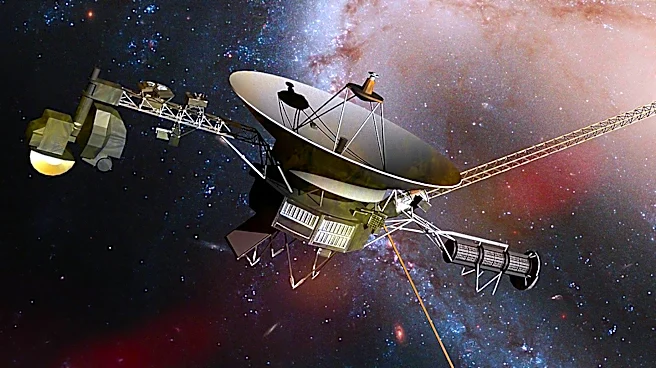
Future research will continue to focus on refining models of Io's interior and the distribution of its internal heat. NASA's Juno mission has already provided valuable data, including the first broad subsurface temperature measurements, which indicate an average heat flow significantly higher than Earth's. These observations suggest that relatively smooth, low-density material covers much of the moon and that unusually warm terrain exists a few meters below the surface. Scientists will continue to analyze data from Juno and other missions to better understand how the heat generated inside Io connects with its changing surface. Further investigations will aim to determine the depth and lateral distribution of tidal dissipation within Io's mantle, which remains an active area of inquiry. This ongoing research will help to build a more complete picture of Io's dynamic geology.
Beyond the Headlines
The extreme tidal heating on Io highlights the profound influence of gravitational interactions in shaping planetary bodies. This process, where orbital energy is converted into internal heat, demonstrates that geological activity is not solely dependent on radioactive decay, as is the case for Earth. The continuous resurfacing of Io by volcanic eruptions means that its surface is remarkably young, lacking the impact craters common on other airless moons. This constant renewal offers a stark contrast to the more static surfaces of many other celestial bodies. The intricate dance between Jupiter and its Galilean moons, particularly the Laplace resonance involving Io, Europa, and Ganymede, is crucial for sustaining Io's intense volcanism. Without the gravitational nudges from Europa and Ganymede, Io's orbit would circularize, and its tidal engine would eventually lose power, leading to a geologically dormant moon. This interconnectedness underscores the complex dynamics within planetary systems.