
What's Happening?
Physicists at the City University of New York's Advanced Science Research Center have successfully reversed electromagnetic waves in time, a phenomenon known as time reflection. This experiment, published
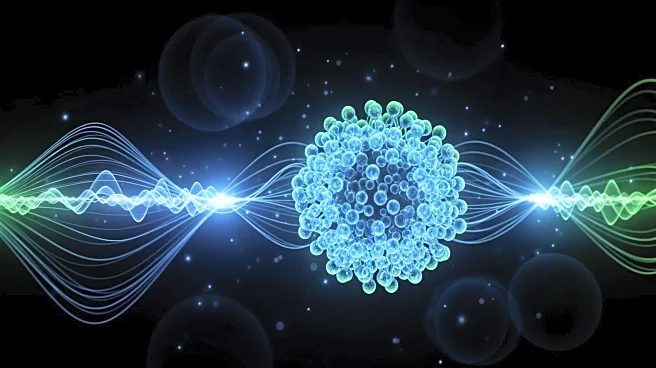
in Nature Physics, marks the first clear and repeatable observation of this effect, which has been a theoretical prediction for decades. The process involves a wave retracing its path backward through time due to a sudden shift in the physical conditions of its environment. The research team achieved this by designing a transmission-line metamaterial with high-speed electronic switches that allowed for near-instant changes in the material's electromagnetic properties. This created a temporal boundary, causing part of the wave to reverse in time. The experiment also demonstrated frequency translation, shifting the signal to a different point in the spectrum.
Why It's Important?
The confirmation of time reflection has significant implications for the field of physics and technology. It provides a new tool for managing energy flow and wave control, potentially leading to advancements in spectrum engineering, adaptive filters, and frequency-selective devices. The ability to reflect a wave in time expands the range of possible behaviors that can be engineered into electromagnetic systems. This breakthrough could influence the development of new technologies in quantum and optical fields, offering real-time control of energy and signal flow. The experiment's success also validates long-standing theoretical models, providing a firm experimental foundation in the electromagnetic domain.
What's Next?
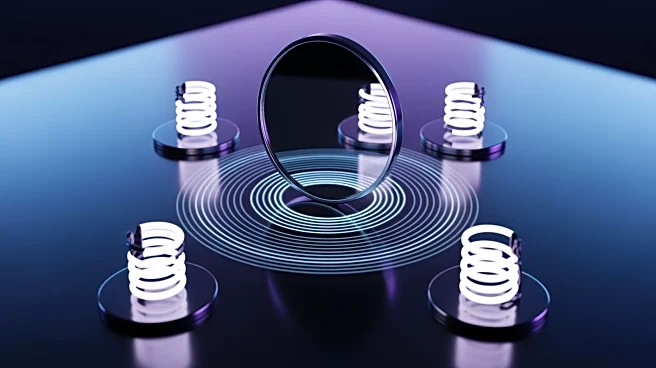
Researchers are exploring practical applications of time reflection, such as using temporal cavities to create novel interference effects. The technology could be adapted to manage different types of waves, including acoustic and mechanical systems. Improving the timing accuracy of the switching circuits is a priority, especially for higher-frequency implementations. Further studies aim to refine the switching process, improve wave fidelity, and explore the potential of combining temporal boundaries with spatial interfaces. As hardware improves, new architectures for time-based computing and communications may emerge.