
What's Happening?
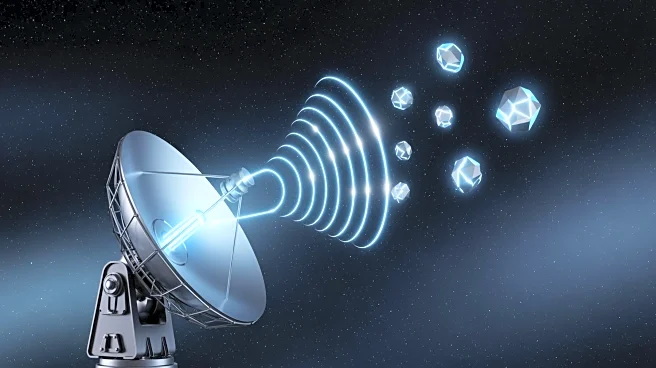
Researchers at the University of Colorado Boulder are developing an electrostatic tractor beam to tackle the growing issue of space debris. This technology aims to safely move defunct satellites out of Earth's
orbit using electrostatic attraction, which involves charging the target satellite negatively and the servicer spacecraft positively. This method allows the two to 'stick' together without physical contact, reducing the risk of damage. The concept, inspired by science fiction, is seen as a safer alternative to current methods like harpoons or nets, which can exacerbate the debris problem. The electrostatic tractor beam is still in its early stages, with significant funding required to bring it to operational status. If successful, it could be a valuable tool in managing the increasing number of satellites and debris in space.
Why It's Important?
The development of an electrostatic tractor beam is crucial as the commercial space industry continues to expand, leading to a significant increase in satellites orbiting Earth. This growth poses a risk of collisions, which can create more debris and threaten operational spacecraft. By providing a touchless method to remove defunct satellites, the tractor beam could help maintain the safety and sustainability of space operations. This technology could also preserve valuable geostationary orbit space, which is essential for communication and weather satellites. The successful implementation of this technology could set a precedent for innovative solutions to environmental challenges in space.
What's Next?
The next steps for the researchers involve conducting further experiments in their Electrostatic Charging Laboratory to refine the technology. Securing funding for a prototype mission is a significant hurdle, as the costs are expected to be in the tens of millions of dollars. The team aims to launch a servicer and a target satellite for initial tests, which would provide more control over the experiments. If funding is secured, a prototype could be operational within a decade. The success of this project could lead to broader adoption of similar technologies for space debris management.
Beyond the Headlines
The development of the electrostatic tractor beam highlights the intersection of science fiction and reality, demonstrating how imaginative concepts can inspire practical solutions to real-world problems. This project also underscores the importance of international collaboration and investment in space sustainability. As space becomes increasingly commercialized, addressing the debris issue is not only a technical challenge but also a regulatory and policy concern. The success of this technology could influence future space policies and encourage further innovation in space debris management.