



What's Happening?
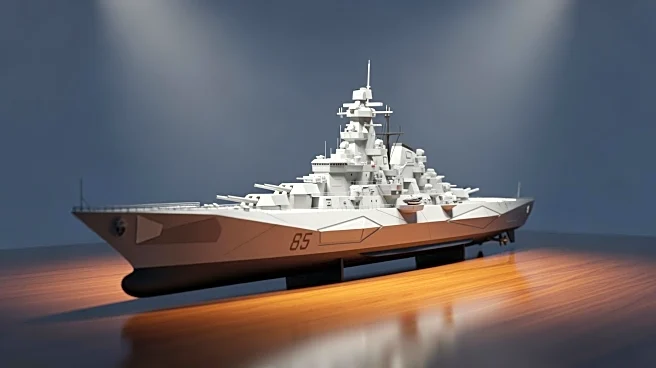
President Trump has announced plans for a new 'Trump-class' battleship, which he claims will be the fastest and most powerful battleship ever built. The announcement was made at Mar-a-Lago, Florida, as part of the U.S. Navy's new Golden Fleet initiative.
The proposed battleship is designed to be equipped with advanced weaponry, including electronic rail guns and laser-based systems, and is intended to maintain American military supremacy. However, defense experts have expressed skepticism about the practicality of the project, noting that battleships have been considered obsolete for decades. The last battleship was built over 80 years ago, and the U.S. Navy retired its last Iowa-class ships nearly 30 years ago. Experts argue that modern naval warfare has shifted towards aircraft carriers and destroyers with long-range missiles.
Why It's Important?
The announcement of the Trump-class battleship raises questions about the direction of U.S. naval strategy and defense spending. Critics argue that the project is more of a prestige initiative than a practical military advancement, potentially diverting resources from more relevant defense technologies. The skepticism from defense experts highlights a potential disconnect between the administration's vision and the realities of modern warfare. If pursued, the project could lead to significant financial and strategic implications for the U.S. Navy, potentially affecting its ability to adapt to current and future threats. The decision to invest in such a project may also influence international perceptions of U.S. military priorities and capabilities.
What's Next?
The future of the Trump-class battleship project remains uncertain, as experts predict that it may face cancellation before any ships are constructed. The program's feasibility will likely be evaluated by future administrations, considering the high costs and strategic misalignment with current naval priorities. The U.S. Navy may need to reassess its focus on distributed firepower and modern naval technologies to ensure effective defense capabilities. Additionally, the project could face scrutiny from Congress and defense analysts, who may question its alignment with national security objectives and budgetary constraints.