
What's Happening?
U.S. Representative Gabe Evans (R-CO) is actively promoting himself as a rancher in his campaign for Colorado's 8th Congressional District, despite previously acknowledging that he raises only a 'few'
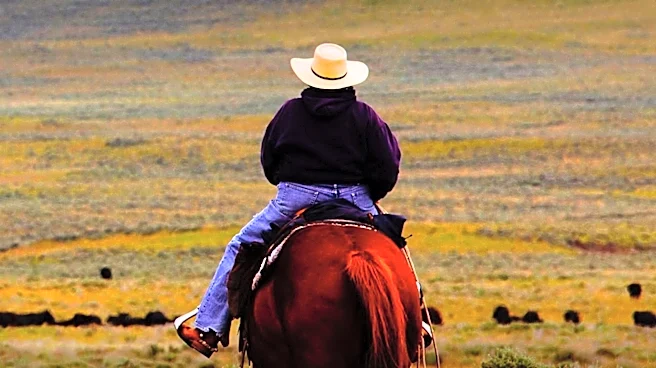
cows as a hobby. A recent campaign advertisement features Evans hauling hay and speaking against a backdrop of cattle. This portrayal is part of a broader effort by Evans to connect with voters in his rural district, north of Denver. He has consistently presented himself as a 'rancher' and 'beef producer' throughout his political career, including during his initial legislative race in 2022 and his 2024 congressional campaign. Critics, including former U.S. Rep. John Salazar (D-CO), have described Evans as 'all hat and no cattle,' noting that his financial disclosures indicate minimal income from livestock sales, falling below the $1,000 threshold typically associated with agricultural tax breaks. Evans' spokeswoman has defended his claims, stating that the U.S. Department of Agriculture labels individuals earning over $1,000 from agricultural products as ranchers or farmers, and that criticism is a distraction from his legislative work.
Why It's Important?
The ongoing emphasis on U.S. Representative Gabe Evans' 'rancher' image is significant as it highlights a common political strategy to cultivate a specific persona that resonates with a constituency, particularly in competitive districts. Colorado's 8th Congressional District is considered a swing district, and the outcome of Evans' race against Democrat Manny Rutinel could influence the balance of power in the U.S. House of Representatives. The debate over the authenticity of Evans' ranching claims underscores the importance of candidate authenticity and how it is perceived by voters. For rural communities, a candidate's connection to agricultural life can be a powerful symbol of shared values and understanding of local economic concerns. However, if these claims are seen as exaggerated or disingenuous, it could lead to voter skepticism and impact trust in political figures. This situation also brings to light the scrutiny political figures face regarding their personal and professional backgrounds, especially when those backgrounds are used as a cornerstone of their public image and campaign messaging.
What's Next?
As the midterm elections approach, the narrative surrounding U.S. Representative Gabe Evans' 'rancher' image is likely to continue to be a point of contention in his campaign against Democrat Manny Rutinel. Both campaigns will likely intensify their efforts to define Evans' public image, with his team continuing to emphasize his connection to rural life and his opponents potentially highlighting the perceived discrepancies in his claims. The effectiveness of this campaign strategy will be tested as voters in Colorado's 8th Congressional District evaluate candidates based on their platforms, perceived authenticity, and ability to represent their interests. The outcome of this high-stakes race will not only determine who represents the district but could also serve as an indicator of the broader political landscape and the types of candidate portrayals that resonate with the electorate in swing districts.
Beyond the Headlines
The discussion surrounding U.S. Representative Gabe Evans' 'rancher' persona delves into deeper implications regarding political branding and the construction of public identity in modern campaigns. In an era where personal narratives often play a crucial role in voter engagement, candidates frequently craft images that align with the perceived values and demographics of their constituencies. This can lead to a blurring of lines between genuine personal experience and strategic political messaging. The scrutiny Evans faces highlights the ethical considerations of how politicians present themselves and the potential for misrepresentation, even if technically within legal bounds. It also reflects a broader societal trend where authenticity is highly valued, and any perceived inauthenticity can be met with public skepticism. This situation could influence how future candidates approach their personal branding, potentially leading to more rigorous verification of claims or a shift towards more transparent self-portrayals to avoid similar controversies.