




What's Happening?
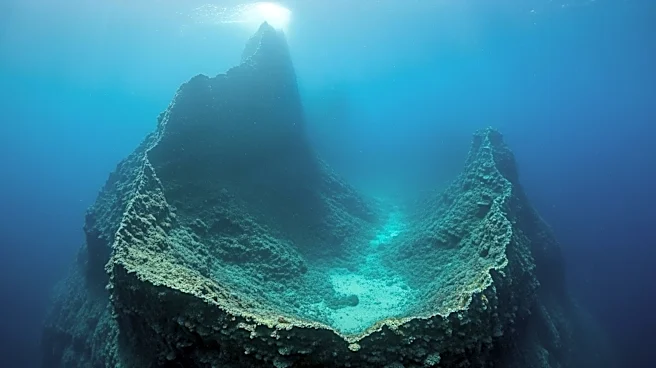
Scientists have confirmed the existence of Zealandia, Earth's hidden eighth continent, which is mostly submerged beneath the South Pacific Ocean. This discovery was made through advanced seabed sampling and magnetic evidence, revealing geological patterns
similar to those found in the seven recognized continents. Zealandia's story began over 100 million years ago as part of the supercontinent Gondwana. Over time, tectonic movements caused Zealandia to drift away and sink beneath the ocean. The findings, including sandstone, volcanic pebbles, and basaltic lavas, confirm Zealandia's status as a distinct continent. Researchers believe that Zealandia's underwater status preserves geological evidence that may not exist on continents exposed above sea level, providing a rare opportunity to study plate movements and continental reshaping.
Why It's Important?
The confirmation of Zealandia as a continent is significant for understanding Earth's geological history and the processes that shape continents. Zealandia offers a unique opportunity to study how tectonic plates shift and reshape landmasses over millions of years. This discovery could lead to new insights into the dynamics of Earth's crust and the history of continental drift. The preserved geological evidence in Zealandia may provide clues about past climates and environmental conditions, contributing to broader scientific knowledge. Additionally, the recognition of Zealandia as a continent may influence geological research priorities and funding, as well as international collaboration in studying this submerged landmass.
What's Next?
Future research on Zealandia is expected to involve advanced tools such as seismic imaging and deep-sea drilling to further explore its structure, history, and formation. International studies and field expeditions are likely to focus on Zealandia's role in global tectonic activity and continental movement. The discovery may also spark debates among scientists about the criteria for defining a continent. As more data is collected, Zealandia could become a focal point for understanding the geological evolution of Earth's continents and the processes that drive their changes over time.