

What's Happening?
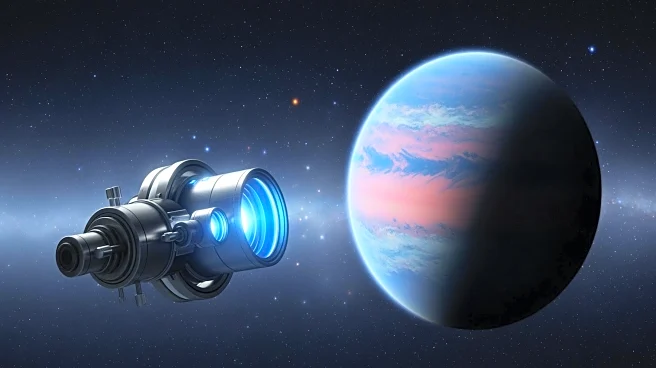
Astronomers are investigating the atmosphere of TRAPPIST-1e, an Earth-sized exoplanet in the habitable zone of the TRAPPIST-1 system, using data from NASA's James Webb Space Telescope. Recent studies published in the Astrophysical Journal Letters suggest
the presence of faint methane signals, raising questions about the planet's atmosphere. However, researchers, including Sukrit Ranjan from the University of Arizona, caution that more evidence is needed to confirm these findings. The TRAPPIST-1 system, located 39 light-years away, consists of seven planets orbiting a red dwarf star, with TRAPPIST-1e being a prime candidate for habitability if it possesses an atmosphere.
Why It's Important?
The potential discovery of an atmosphere on TRAPPIST-1e could have profound implications for the search for extraterrestrial life. An atmosphere capable of supporting liquid water would increase the likelihood of life existing on the planet. The findings also highlight the capabilities of the James Webb Space Telescope in studying distant exoplanets, despite its primary design not being focused on Earth-sized worlds. Understanding the atmospheric composition of TRAPPIST-1e could provide insights into the conditions necessary for life and inform future exoplanet exploration missions.
What's Next?
Further observations and analysis are needed to confirm the presence of an atmosphere on TRAPPIST-1e. Upcoming missions, such as NASA's Pandora, aim to study exoplanet atmospheres and their host stars, potentially resolving current uncertainties. Researchers are also developing new methods, like dual transit observations, to distinguish between stellar and planetary signals. These efforts will enhance our understanding of TRAPPIST-1e and similar exoplanets, contributing to the broader goal of identifying habitable worlds beyond our solar system.