






What's Happening?
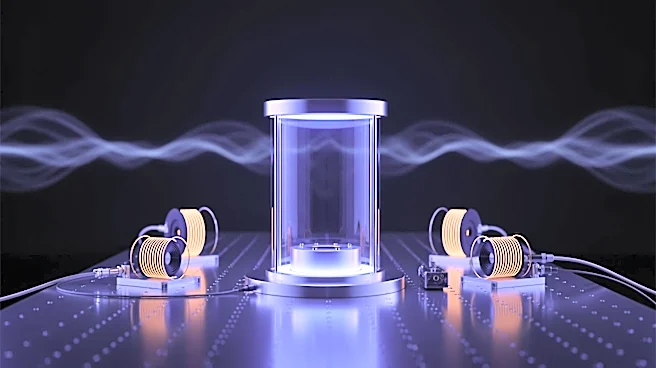
A group of undergraduate students from the University of Hamburg has conducted a small-scale experiment to search for axions, a candidate for dark matter, setting new experimental limits on their properties. The experiment involved building a cavity detector
using highly conductive materials and electronics, supported by the university and collaborating research groups. Despite limited resources, the students achieved meaningful scientific results by excluding the presence of axions with certain properties within the explored mass range. The study, published in the Journal of Cosmology and Astroparticle Physics, demonstrates that small-scale experiments can contribute to the search for dark matter, traditionally dominated by large observatories and complex instruments.
Why It's Important?
The student-led experiment highlights the potential for small-scale research initiatives to make significant contributions to the field of dark matter research. By setting new limits on axion properties, the study helps narrow the parameter space for future searches, guiding larger experiments in their quest to identify dark matter particles. This approach underscores the value of innovation and agility in scientific research, allowing young researchers to explore complex challenges with limited resources. The experiment also emphasizes the importance of collaboration between academic institutions and research groups, fostering an environment where students can engage in cutting-edge scientific endeavors.
What's Next?
The results of the student-led experiment may inspire similar initiatives at other academic institutions, encouraging young researchers to pursue small-scale projects in the field of dark matter research. As the search for axions continues, larger experiments may build upon the findings to explore new regions of the parameter space. The study's success could lead to increased support for student-led research, promoting educational opportunities and workforce development in the field of cosmology and astrophysics. Future experiments may focus on enhancing sensitivity and expanding the search window to increase the likelihood of detecting axions.