


What's Happening?
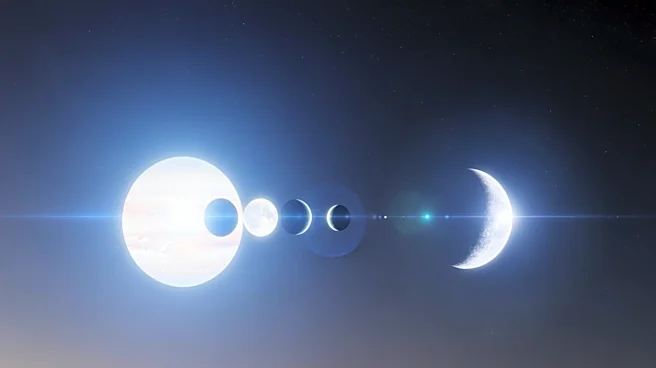
On April 2, sky watchers in the U.S. have the opportunity to observe a series of celestial events involving Jupiter and Mercury. Jupiter's four Galilean moons, including Europa and Callisto, will be visible as Europa passes north of Callisto. Additionally,
Ganymede's shadow will transit across Jupiter's cloud tops, providing a striking view for observers, particularly in the western half of the U.S. where the view is less obstructed by Jupiter's low position. Meanwhile, Mercury becomes visible in the early morning sky, reaching its greatest western elongation on April 3. The planet can be seen shining at magnitude 0.4, rising around 5:45 A.M. local daylight time, and appearing 4° above the eastern horizon about half an hour before sunrise. Mars and Saturn are also present in the morning sky, though Mars is faint and requires optical aid to be seen.
Why It's Important?
These astronomical events offer a unique opportunity for both amateur and professional astronomers to observe and study the dynamics of our solar system. The visibility of Jupiter's moons and Mercury provides a chance to engage with celestial phenomena that are not always easily observable. Such events can inspire interest in astronomy and science education, encouraging people to learn more about the universe. Additionally, these observations can contribute to ongoing research and data collection efforts, enhancing our understanding of planetary movements and interactions.
What's Next?
As Mercury continues to rise in the morning sky, its visibility will improve, allowing for better observation opportunities. Mars and Saturn will also become more prominent as they rise higher in the sky over the coming days. Observers are encouraged to take advantage of clear skies and minimal light pollution to maximize their viewing experience. Future celestial events will continue to provide opportunities for observation and study, fostering a deeper appreciation for the complexities of our solar system.