



What's Happening?
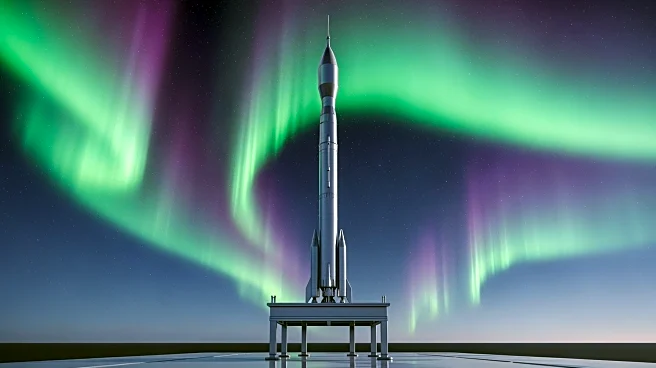
NASA has successfully launched two sounding rocket missions from Alaska to investigate the electrical forces behind the northern lights. The missions, named the Black and Diffuse Auroral Science Surveyor and the Geophysical Non-Equilibrium Ionospheric
System Science (GNEISS), were launched from the Poker Flat Research Range near Fairbanks. The rockets reached altitudes of approximately 224 miles and 198 miles, respectively, and returned high-quality data. These missions aim to map the electrical currents that power the auroras, which are caused by electrons streaming into Earth's upper atmosphere. The GNEISS mission, in particular, uses a 3D scanning technique to understand how these currents close the circuit in the atmosphere.
Why It's Important?
Understanding auroral currents is crucial for comprehending how energy from space is distributed through Earth's upper atmosphere. These currents can affect atmospheric conditions, including heating and turbulence, which in turn impact satellites. By combining data from ground-based instruments, satellites, and sounding rockets, scientists can gain a comprehensive view of the auroral system. This research is vital for improving predictions of space weather, which can have significant implications for satellite operations and communication systems.
What's Next?
The data collected from these missions will be analyzed to provide insights into the behavior of auroral currents and their impact on space weather. This information could lead to improved models for predicting space weather events, which are critical for the safety and functionality of satellites and other space-based technologies. Continued collaboration between ground-based and space-based observations will enhance our understanding of the complex interactions between Earth's atmosphere and space.