



What's Happening?
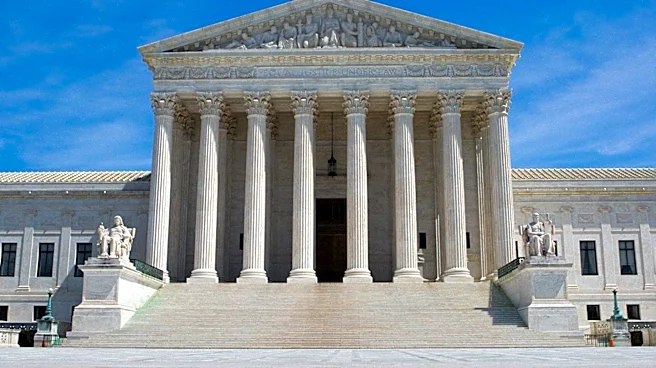
The U.S. Supreme Court has declined to review a petition in the case of Rieth-Riley Construction Co. v. NLRB. The employer, Rieth-Riley Construction Co., had argued that the Sixth Circuit Court of Appeals improperly allowed the National Labor Relations
Board (NLRB) to reinterpret one of its own long-standing precedents without independently analyzing the precedent's original meaning. The case centered on the NLRB's 1958 decision in Retail Associates, which governs withdrawal from multiemployer bargaining units. Rieth-Riley contended that the NLRB effectively rewrote this rule by interpreting 'the agreed-upon date' for bargaining to begin as 'any agreed-upon date,' thereby allowing a union to withdraw even when no specific bargaining date had been set. The employer argued that this interpretation nullified part of the original rule and contradicted the text of the Board's own precedent, and that the Sixth Circuit wrongly deferred to the agency's reading.
Why It's Important?
The Supreme Court's decision not to hear this case means that, for now, the question of how courts should scrutinize federal agencies' interpretations of their own adjudicative precedents remains largely unsettled. This has significant implications for regulatory certainty and the balance of power between agencies and the judiciary. Many federal agencies, including the NLRB, create policy through case-by-case adjudication rather than formal rulemaking. If agencies can reinterpret their precedents without meaningful judicial scrutiny, it could allow them to alter legal standards without openly acknowledging policy changes, potentially leading to unpredictable regulatory environments for businesses. The employer's argument, drawing on Supreme Court decisions like Loper Bright, highlighted the need for courts to independently construe agency standards, even those established through adjudication, to ensure reasoned decision-making and prevent agencies from silently recharacterizing their own rules.
What's Next?
With the Supreme Court declining review, the Sixth Circuit's ruling in favor of the NLRB stands, at least for this specific case. This means the NLRB's interpretation of its Retail Associates precedent will continue to be applied as upheld by the Sixth Circuit. However, the broader issue of judicial scrutiny over agency adjudicative precedents is likely to resurface in future cases. Employers and other regulated entities will continue to seek clarity on the extent to which courts must independently interpret agency-created rules, particularly in light of recent Supreme Court jurisprudence emphasizing judicial oversight of agency actions. The ongoing debate over agency deference and the proper role of courts in reviewing administrative decisions will continue to be a significant area of legal contention.
Beyond the Headlines
This case touches upon a fundamental aspect of administrative law: how federal agencies, which possess both rulemaking and adjudicatory powers, are held accountable to the law. The employer's argument underscored the concern that when agencies develop policy through adjudication, rather than formal rulemaking, the process can be less transparent and subject to less public input. The lack of independent judicial review over an agency's reinterpretation of its own precedents could be seen as undermining the Administrative Procedure Act's safeguards for reasoned decision-making. This issue extends beyond labor law, affecting various sectors regulated by agencies like the Federal Trade Commission, Securities and Exchange Commission, and Environmental Protection Agency, all of which also issue rules through adjudication. The Supreme Court's decision to pass on this opportunity leaves a critical area of administrative law open for further legal challenges and potential future intervention.