

What's Happening?
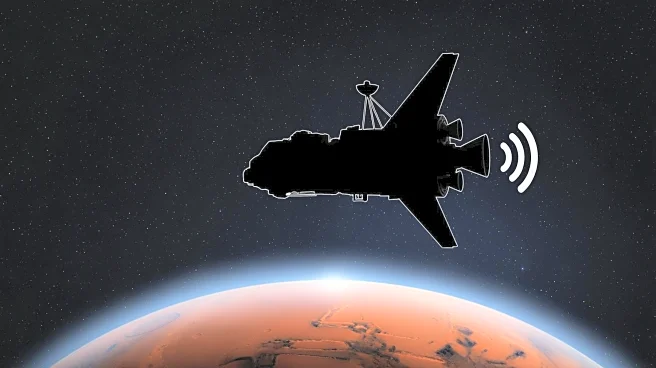
NASA has lost contact with the MAVEN Mars orbiter, a critical component of its Mars exploration program. The loss of signal occurred on December 6, 2025, as the spacecraft passed behind Mars. MAVEN, which has been orbiting Mars since 2014, plays a vital
role in studying the planet's upper atmosphere and serves as a communications relay for the Curiosity and Perseverance rovers. NASA confirmed the loss of contact on December 9, and teams are actively working to diagnose the issue and restore communication. The cause of the anomaly has not been disclosed, and no major hardware failures have been identified. MAVEN's silence poses a challenge to Mars operations, as it is a key part of the relay network that supports data transmission from the Martian surface to Earth.
Why It's Important?
MAVEN's loss of contact is significant because it affects the communication infrastructure for Mars missions. The orbiter is crucial for relaying data from surface missions like Curiosity and Perseverance, which rely on orbiters to send large volumes of data back to Earth. Without MAVEN, the bandwidth and scheduling flexibility for data transmission could be reduced, potentially limiting the amount of scientific data returned from Mars. The incident underscores the importance of maintaining a robust and reliable communications network for planetary exploration. It also highlights the challenges of operating aging spacecraft and the need for new investments in Mars infrastructure.
What's Next?
NASA is focused on re-establishing contact with MAVEN. Engineering teams are exploring various recovery options, including listening for signals and sending blind commands to the spacecraft. If contact cannot be restored, NASA may need to rely more heavily on other orbiters like Mars Reconnaissance Orbiter and Mars Odyssey, which are also aging. The situation may accelerate plans for a new Mars telecommunications orbiter to ensure continued support for future missions. NASA is expected to provide updates as the situation develops, and the scientific community will be closely monitoring the impact on ongoing Mars research.