



What's Happening?
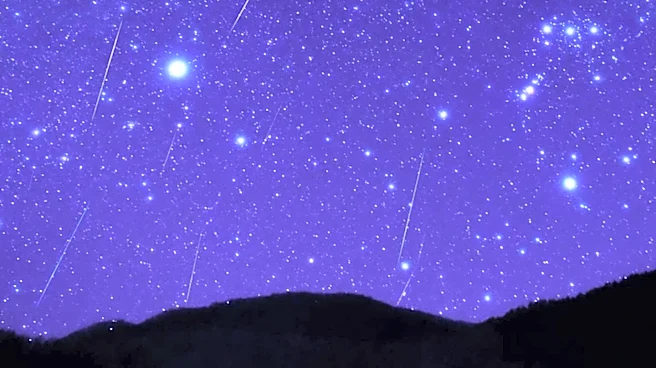
November 2026 is set to offer several opportunities for skywatchers across the United States to observe meteor showers. NASA has highlighted three main events: the Southern Taurids, the Northern Taurids, and the Leonids. The Southern Taurids are expected
to peak around November 5, known for producing bright meteors, or 'fireballs,' with an estimated rate of about five meteors per hour under ideal conditions. Following this, the Northern Taurids will peak around November 12, also producing approximately five meteors per hour. The most anticipated event, the Leonid meteor shower, is slated to peak around November 17, with NASA recommending observation during the early morning hours of November 17 and 18, particularly after moonset. The Leonids could potentially offer up to 15 meteors per hour under optimal viewing conditions. These celestial events are observable without specialized equipment, requiring only dark skies and patience.
Why It's Important?
These meteor showers provide a significant opportunity for public engagement with astronomy, offering accessible natural phenomena that do not require specialized equipment. For astronomy enthusiasts and the general public, these events can foster an interest in space science and the cosmos. The potential for bright fireballs from the Taurids, despite their lower meteor count, adds an element of spectacle that can capture widespread attention. The Leonids, historically known for meteor storms, while not expected to produce such intensity this year, still offer a reliable annual display. These events also serve as a reminder of Earth's journey through cosmic debris, originating from comets like 2P/Encke for the Taurids and 55P/Tempel-Tuttle for the Leonids, illustrating fundamental principles of orbital mechanics and solar system dynamics.
What's Next?
Skywatchers in the U.S. should prepare for optimal viewing conditions by finding dark locations away from light pollution. For the Taurids, late evening viewing is recommended as the constellation Taurus rises higher. For the Leonids, the hours between midnight and dawn are generally better, especially after moonset on November 17 and 18. Observers are advised to allow about 30 minutes for their eyes to adapt to the darkness and to avoid bright screens. Following November's events, the Geminid meteor shower is expected to peak around December 13-14, potentially offering one of the year's strongest displays with a theoretical peak rate of approximately 150 meteors per hour, making it another significant event for skygazers before the end of the year.
Beyond the Headlines
Beyond the immediate spectacle, these meteor showers underscore the continuous interaction between Earth and the vast amount of cosmic debris in our solar system. The study of these meteoroids, their origins, and their composition provides scientists with valuable insights into the early solar system and the materials that formed planets. The varying intensity and characteristics of different meteor showers, such as the fireball-producing Taurids versus the more numerous Leonids, reflect the diverse nature of cometary debris trails. Public interest generated by these events can also indirectly support scientific research and educational initiatives in astronomy, encouraging future generations to pursue STEM fields and contribute to our understanding of the universe.