



What's Happening?
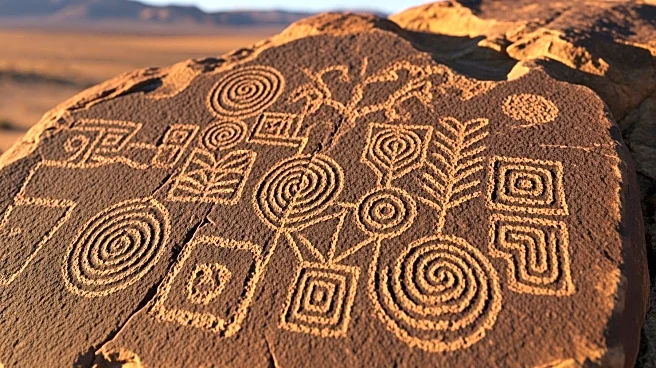
Researchers have discovered ancient rock art in northern Arabia, dating back 12,800 to 11,400 years, which served as maps to water sources in the desert. The engravings, found on cliffs and rock faces, depict life-sized animals and are believed to have marked
water sources and movement routes. This discovery was made by an international team under Saudi Arabia's Heritage Commission and the Green Arabia Project. The art, featuring camels, ibex, and other animals, is thought to signify territorial rights and cultural identity. The engravings are linked to a period when seasonal water returned to the region, allowing people to inhabit the desert interior.
Why It's Important?
The discovery of these engravings provides valuable insights into the lives of ancient desert communities and their adaptation to environmental changes. The rock art not only marks water sources but also reflects the cultural and social dynamics of the time, indicating territorial claims and intergenerational memory. This finding enhances our understanding of human resilience and innovation in arid environments. It also highlights the interconnectedness of ancient communities, as evidenced by the presence of Levantine-style tools and ornaments, suggesting long-distance interactions and cultural exchanges.
What's Next?
Further research is planned to explore additional rock art panels along the Nefud Desert's southern margin. Systematic mapping, sediment coring, and targeted excavations will help refine the dating and contextual understanding of these engravings. Researchers aim to uncover more about the relationship between the rock art, campsites, and trails, as well as the cultural exchanges between ancient Arabian and Levantine communities. This ongoing research will continue to shed light on the historical significance of these engravings and their role in the cultural landscape of ancient Arabia.