
What's Happening?
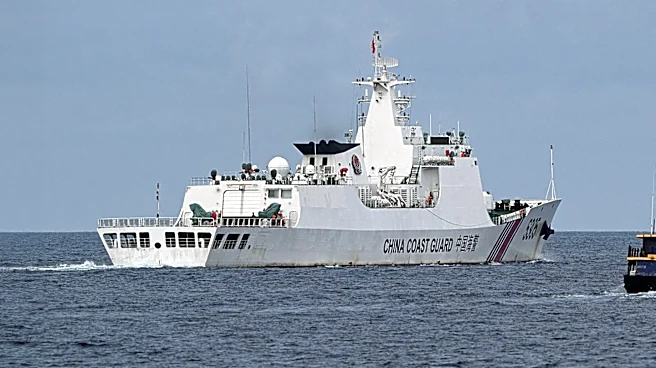
Following China's test of a Julang ballistic missile in the Pacific Ocean on July 6, 2026, a summit of regional actors in Palau failed to issue a unified condemnation of the military exercise. The missile test,
announced by Xinhua News, involved a likely Julang-2 (JL-2) or Julang-3 (JL-3) intercontinental ballistic missile fired from a nuclear-powered submarine, with the JL-3 having the range to reach the continental United States. While countries like Australia and New Zealand expressed concern over the short notice of the exercise, many Pacific Island nations, including the Solomon Islands and Fiji, adopted a more restrained stance, emphasizing their 'friendship' with China. This lack of consensus, particularly due to objections from Kiribati and Naoero, highlighted growing political divisions and a potential geopolitical shift away from Western influence in the Pacific. Despite initial strong statements from some Pacific foreign ministers, the forum ultimately could not present a unanimous position.
Why It's Important?
The inability of Pacific nations to collectively condemn China's missile test underscores a significant shift in regional dynamics and poses challenges to U.S. and Western influence in the Indo-Pacific. China's strategic investments in infrastructure and climate change assistance in Oceania are fostering closer ties, potentially eroding traditional alliances. The JL-3 missile's capability to reach the continental U.S. from waters near mainland China represents a direct security concern for the United States, emphasizing the strategic importance of the Pacific. The growing division among Pacific Island nations, with some prioritizing economic benefits from China over unified security concerns, complicates efforts to form a united front against China's expanding military presence. This situation could lead to increased geopolitical competition in the region, impacting trade routes, resource access, and overall stability, and requiring the U.S. to re-evaluate its engagement strategies in the Pacific.
What's Next?
The observed divisions among Pacific nations suggest that China will likely continue its strategy of economic engagement and military presence in the region, potentially further solidifying its influence. The U.S. and its allies will need to enhance their diplomatic and economic efforts to counter China's growing sway, possibly by offering more compelling alternatives for development and security assistance. This could involve strengthening existing defense pacts, increasing aid for climate change resilience, and fostering deeper cultural and economic ties. However, the challenge remains in convincing all Pacific nations to align with Western interests, especially those that have become increasingly reliant on Chinese investment. Future military exercises by China in the Pacific are probable, and the response from regional actors will continue to be a key indicator of evolving geopolitical alignments. The U.S. will need to carefully navigate these complex relationships to maintain its strategic interests in the region.
Beyond the Headlines
The failure to achieve a unified condemnation goes beyond immediate security concerns, revealing deeper ethical and cultural dimensions. Many Pacific Island nations face existential threats from climate change, making them highly susceptible to offers of assistance, regardless of the geopolitical implications. This creates a moral dilemma for Western powers: how to address the urgent needs of these nations without inadvertently pushing them further into China's sphere of influence. The concept of 'friends to all,' as expressed by Fiji, reflects a desire for neutrality and self-preservation in a world increasingly polarized by great power competition. This highlights the importance of understanding the unique vulnerabilities and priorities of smaller nations, rather than imposing a singular geopolitical agenda. The long-term consequence could be a redefinition of sovereignty and alliance structures in the Pacific, where economic and environmental security become as critical as traditional military alliances.