







What's Happening?
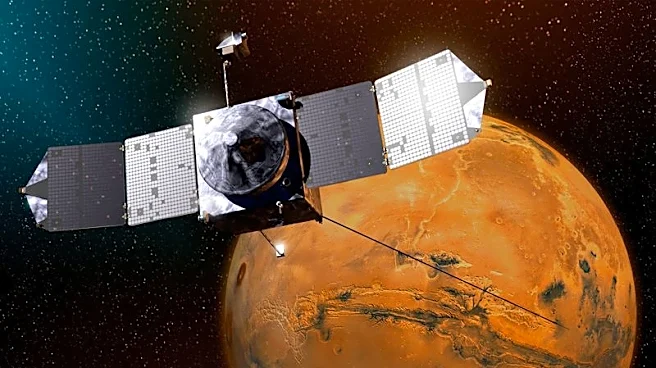
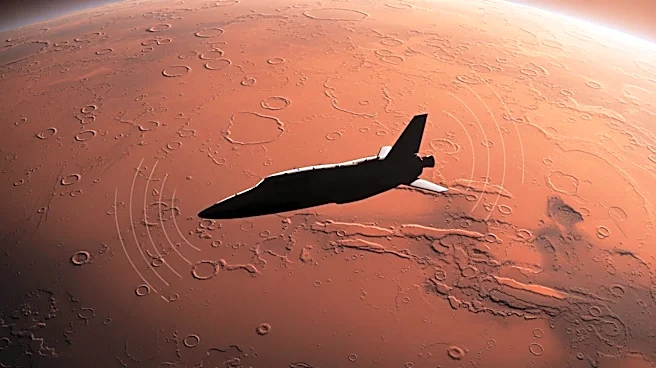
NASA's Psyche spacecraft has successfully completed a flyby of Mars, coming within 2,864 miles of the planet's surface. This maneuver provided a gravity assist, boosting the spacecraft's speed by 1,000 miles per hour and adjusting its orbital plane. The
spacecraft is now on course to reach the metal-rich asteroid Psyche, located in the main asteroid belt between Mars and Jupiter, by summer 2029. During the flyby, Psyche's instruments were calibrated, capturing unique images of Mars and gathering data to prepare for its mission at the asteroid.
Why It's Important?
The successful Mars flyby marks a significant milestone in NASA's mission to explore the asteroid Psyche, which is believed to be the exposed core of a planetesimal. Studying this asteroid could provide unprecedented insights into the building blocks of rocky planets like Earth. The mission's findings could enhance our understanding of planetary formation and the composition of celestial bodies, contributing to the broader field of planetary science. Additionally, the mission demonstrates the effectiveness of gravity assists in space exploration, potentially informing future missions.
What's Next?
Following the Mars flyby, the Psyche spacecraft will continue its journey using solar-electric propulsion to reach the asteroid by August 2029. Once there, it will enter orbit and conduct a series of scientific observations to map the asteroid and analyze its composition. The mission's success could pave the way for future explorations of similar celestial bodies, expanding our knowledge of the solar system. Continued monitoring and data collection will be crucial as the spacecraft approaches its target.