







What's Happening?
Archaeologists have uncovered six previously unknown Bronze Age mining sites in Extremadura, southwestern Spain. These discoveries, made during a February survey by the University of Gothenburg's Maritime Encounters program, could provide answers to the origins
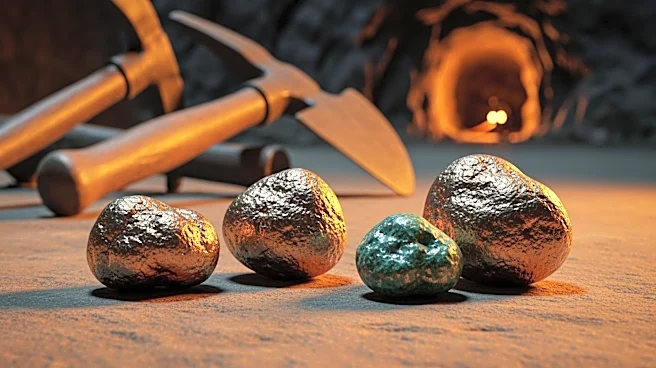
of metal used in Scandinavian Bronze Age artifacts. The fieldwork, conducted in partnership with the Universidad de Sevilla and the Museo Arqueológico Provincial de Badajoz, documented six distinct mining locations, including one with about 80 grooved stone axes used for ore processing. The mines contain copper, lead, and silver, which were crucial to Bronze Age economies and traded over long distances.
Why It's Important?
The discovery of these mines enhances the understanding of ancient trade networks and the interconnectedness of Bronze Age Europe. It suggests that metal extraction in southwestern Europe was more extensive and organized than previously thought, providing a concrete archaeological context for chemical and isotopic analyses of Scandinavian artifacts. This could reshape historical narratives about the economic and cultural exchanges in ancient Europe, highlighting the region's role in early European trade networks.
What's Next?
Further archaeological investigations are likely to continue in the region, potentially uncovering more sites and artifacts that could offer additional insights into Bronze Age trade and industry. Researchers may also conduct more detailed analyses of the metals found to better understand their distribution and use across Europe. These findings could lead to new collaborations between international research teams and institutions.
Beyond the Headlines
The discoveries may prompt a reevaluation of the technological capabilities and social organization of Bronze Age societies in Europe. Understanding the scale and complexity of ancient mining operations could influence modern perspectives on resource management and economic development in historical contexts.