
What's Happening?
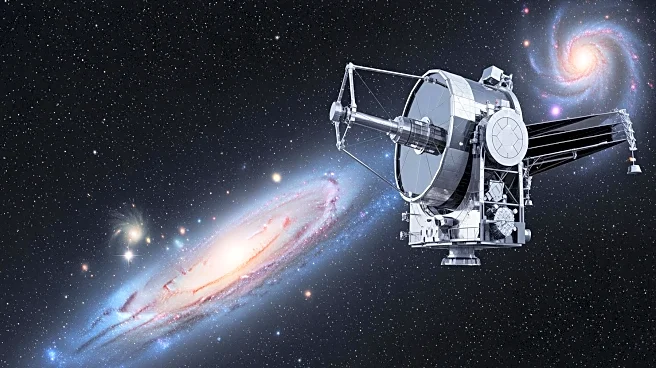
NASA's James Webb Space Telescope has detected the farthest known galaxy, designated MoM-z14, using its Near-Infrared Camera (NIRCam) and confirmed with its Near-Infrared Spectrograph (NIRSpec). This galaxy is observed
as it was 280 million years after the Big Bang, with its light traveling over 13 billion years to reach Earth. MoM-z14 is noted for being brighter, more compact, and more chemically enriched than expected for its era. While it may soon be surpassed as the farthest galaxy, its discovery provides valuable insights into the early universe and the formation of galaxies.
Why It's Important?
The discovery of MoM-z14 by the James Webb Space Telescope is a significant milestone in understanding the early universe. It challenges existing theories about galaxy formation and chemical enrichment shortly after the Big Bang. The findings could lead to new models of how galaxies evolve and interact in the universe's infancy. This discovery also underscores the capabilities of the James Webb Space Telescope in pushing the boundaries of observable space, offering astronomers a powerful tool to explore the cosmos and uncover the universe's earliest secrets.
Beyond the Headlines
The detection of MoM-z14 raises questions about the processes that led to its unexpected brightness and chemical composition. It suggests that galaxy formation in the early universe may have been more complex than previously thought, potentially involving rapid star formation and interactions. This discovery could prompt a reevaluation of the timeline and mechanisms of galaxy evolution, influencing future research and observations. The James Webb Space Telescope's ability to peer into the distant past also opens up possibilities for discovering other ancient cosmic phenomena, further enriching our understanding of the universe's history.