






What's Happening?
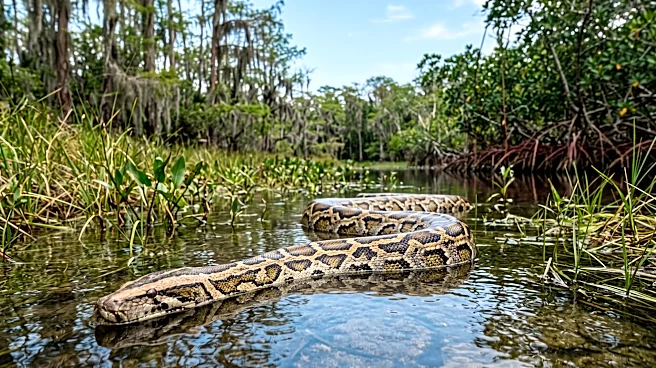
University of Florida (UF) researchers are employing machine learning to refine strategies for removing invasive Burmese pythons from the Florida Everglades. The new study prioritizes the removal of pythons based on their reproductive potential, aiming
to maximize the impact on population control. Alex Romer, a quantitative ecologist with the Croc Docs Wildlife Research Team and lead author, explained that previous efforts treated all pythons as equally contributing to the population. However, the new approach recognizes that large, reproductive females have a significantly greater impact on population growth. The machine learning model focuses on factors such as age, size, sex, and reproductive potential to identify and target these key demographic individuals for removal.
Why It's Important?
This research is crucial for the ecological health of the Florida Everglades, a vital and unique ecosystem. The Burmese python invasion has severely impacted native wildlife populations, disrupting the food chain and threatening biodiversity. By targeting the most prolific pythons, the UF study offers a more efficient and effective method for managing the invasive species, potentially leading to a significant reduction in their numbers. This approach could save considerable resources and time compared to indiscriminate removal efforts. The success of this machine learning application in conservation could also serve as a model for addressing other invasive species challenges across the U.S. and globally, demonstrating the power of advanced technology in environmental protection.
What's Next?
The UF researchers have developed a Weighted Removal Index (WRI), a demographic weighting system that assigns an ecological value to pythons based on their likelihood to survive and reproduce. This index will guide future removal efforts, particularly in new invasion sites and along the invasion front, where targeted interventions can have the greatest impact. The next steps will involve implementing this WRI in the field, continuously collecting data, and refining the machine learning model to further optimize python removal strategies. The success of this program could lead to increased funding and broader adoption of similar technology-driven conservation methods by other environmental agencies and research institutions.
Beyond the Headlines
Beyond the immediate ecological benefits, this study highlights the growing intersection of artificial intelligence and environmental conservation. The application of machine learning to identify and prioritize invasive species removal demonstrates a shift towards more data-driven and scientifically informed conservation practices. This approach raises ethical considerations regarding the selective targeting of animals, even invasive ones, and the potential for unintended consequences if the models are not robustly validated. Furthermore, it underscores the long-term commitment required to manage invasive species, as these challenges often involve complex ecological interactions and require continuous adaptation of strategies. The success of this project could inspire further innovation in using technology to address pressing environmental issues, fostering a new era of conservation efforts.