
What's Happening?
The Cleveland Fed’s Inflation Nowcasting model projects that October’s core Personal Consumption Expenditures (PCE) inflation will remain at 3.2% year-over-year, exceeding the Federal Reserve's 2.0% target.
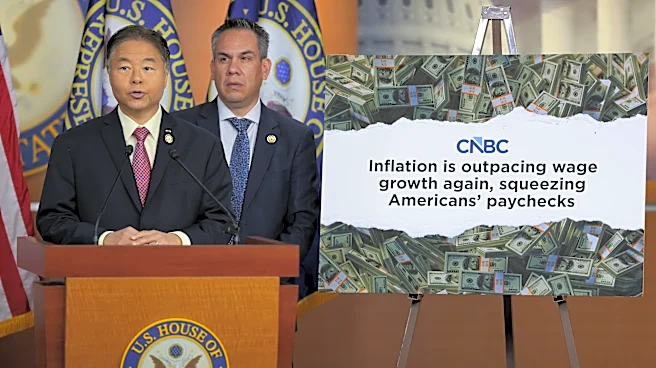
This follows a projected headline PCE inflation rate of 3.8% year-over-year for the same month. Both headline and core PCE inflation rates are anticipated to increase further in November. Additionally, the model forecasts that the core Consumer Price Index (CPI) will ease slightly to 2.5% year-over-year in October from 2.6%, but still remain above the target. October would mark the 68th consecutive month of CPI inflation above 2.0% year-over-year. San Francisco Fed President Mary Daly indicated that the Federal Reserve will likely need to tighten policy further, citing a stable but not booming job market and real wages falling behind inflation.
Why It's Important?
Persistent core inflation above the Federal Reserve's target has significant implications for U.S. monetary policy and economic stability. The Federal Reserve's primary mandate includes maintaining price stability, and continued elevated inflation pressures could lead to further interest rate hikes. Such actions would increase borrowing costs for consumers and businesses, potentially slowing economic growth and impacting investment decisions. Industries reliant on consumer spending, such as retail and housing, could face headwinds. For consumers, real wages continue to decline as pay increases fail to keep pace with inflation, eroding purchasing power and affecting household budgets. Businesses may also face increased operational costs due to higher producer prices, particularly in sectors like transportation and warehousing, where costs have surged due to factors like rising diesel prices.
What's Next?
The upcoming releases of October’s CPI and Producer Price Index (PPI) reports on Tuesday and Friday, respectively, will provide further clarity on inflationary trends. These reports are crucial for the Federal Reserve as it assesses the need for future policy adjustments. Ten Fed officials are scheduled to speak this week, and their remarks will be closely scrutinized for indications of the central bank's stance on inflation and interest rates. The market is currently pricing in a 78% chance of a December rate hike, suggesting that further tightening is widely expected. Continued hawkish sentiment from Fed officials, especially following strong employment data, reinforces the expectation of additional rate increases to bring inflation under control.
Beyond the Headlines
The sustained period of inflation above the Federal Reserve's target highlights a broader challenge in balancing economic growth with price stability. The current environment, characterized by a strong job market alongside declining real wages, presents a complex scenario for policymakers. The impact of rising producer prices, particularly in transportation and warehousing, suggests that supply-side pressures continue to contribute to inflation, making it more difficult to address solely through demand-side monetary policy. The long-term erosion of purchasing power due to inflation could lead to increased social and economic inequality, as those with fixed incomes or less bargaining power for wage increases are disproportionately affected. This situation could also prompt a re-evaluation of the effectiveness of current monetary policy tools in addressing multifaceted inflationary pressures.